
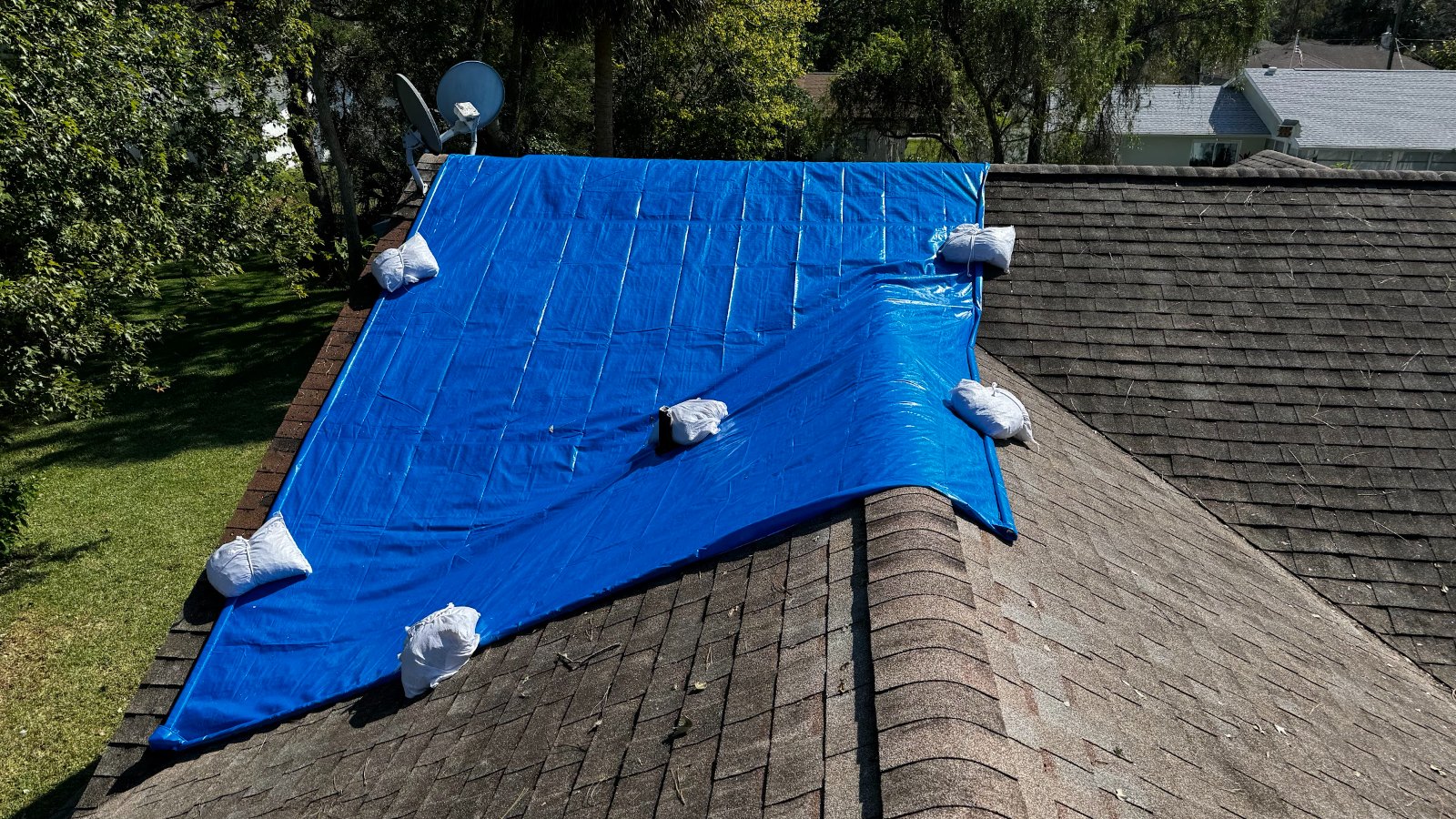
Hurricane Ian carrier lessons come down to one point: emergency tarping capacity has to be committed before landfall, not found after it. Tarpers is an emergency roof tarping company that works on assignment from property insurance carriers in Florida, Georgia and other southeastern states, and the numbers from Ian show why carriers now plan tarping capacity as carefully as adjuster capacity.
Ian came ashore in southwest Florida on September 28, 2022, and the Florida Office of Insurance Regulation later counted 789,066 claims tied to the storm. This post looks at what that volume meant for emergency mitigation vendors and what claims leaders and vendor managers can build into their vendor programs today.
What happened when Hurricane Ian made landfall?
According to the National Hurricane Center's Tropical Cyclone Report on Ian, Ian made landfall on Cayo Costa as a Category 4 hurricane with 130 knot winds, then made a second landfall near Punta Gorda about 90 minutes later. Peak storm surge inundation reached 10 to 15 feet above ground level in Fort Myers Beach, and at least 52,514 structures were impacted in Lee County alone.
Ian then moved across the state, flooding counties north of its track including Charlotte, Sarasota, Hardee, DeSoto, Polk and Manatee, and made a final landfall near Georgetown, South Carolina. The NHC estimates $112.9 billion in total U.S. damage, making Ian the costliest hurricane to ever affect Florida and the third costliest U.S. hurricane on record.
How many claims did Hurricane Ian generate in Florida?
The Florida OIR Hurricane Ian claims data, as of March 4, 2025, lists 789,066 total claims, 565,101 of them residential property claims, with estimated insured losses of about $22.2 billion. OIR notes that the aggregate data has not been audited or independently verified.
For a vendor manager, the takeaway is concentration. Hundreds of thousands of residential claims landed in a handful of counties within the same few weeks, and every open roof in that group needed a tarp before interior water damage could grow.
What are the biggest Hurricane Ian carrier lessons about vendor capacity?
The first lesson is that volume arrives all at once. Insurance Journal reported that McLarens saw a 1,110% increase in Florida claim notifications over the same 10 day period a year earlier, and State Farm said incoming claims staff arrived at a rate of 100 claims handlers per hour. Carriers scaled their adjusters fast. Mitigation vendors have to scale on the same curve, because a roof waiting on a tarp is a roof still taking on water intrusion.
The lessons that follow for tarping vendors:
- Capacity has to be committed before the storm, with crews, materials and logistics named in advance.
- Access is a logistics problem as much as a labor problem.
- Documentation has to keep pace with assignment volume, or files stall at review.
- Fewer vendors to manage means fewer hand offs and more consistent quality.
Why does access matter as much as crew count after a major hurricane?
Insurance Journal's reporting from southwest Florida described flooding, damaged cell towers and road closures that complicated the claims response. Some areas, including Sanibel Island, could be reached only by boat or helicopter or were closed to everyone except residents. Adjusters needed a state issued ID card in their vehicle to enter certain areas, and local limits on drone flights delayed some damage assessments.
A tarping vendor with plenty of crews still loses days if those crews cannot get in or arrive without materials. Tarpers crews carry their own equipment and logistics, so a deployment does not depend on local supply in a damaged area.
How fast can a tarping vendor deploy after a hurricane like Ian?
Tarpers teams mobilize within hours of a catastrophic event declaration, with pre positioned equipment and trained crews. When an assignment arrives, Tarpers contacts the property owner within hours to schedule service and works dawn to dusk, 7 days a week.
Speed matters because each day a damaged roof stays open can add interior water damage and raise claim severity. Our post on cycle time benchmarks covers what carriers measure.
What does proven surge capacity look like?
Tarpers has completed 1,000+ tarp assignments across seven named storms, including 475+ assignments in under two months after Hurricane Milton. That kind of record tells a vendor manager whether a vendor can take a large, fast wave of assignments in Florida and keep the install standard the same from the first job to the last.
You can see Tarpers work across Florida on our completed projects page, and how deployments are staffed on the catastrophe response page. For the planning side, see scaling tarping CAT response.
How should documentation scale during a catastrophe?
At Ian's volume, a photo set that arrives late or incomplete turns into a reinspection, a supplement or a dispute. Tarpers photographs every job before, during and after the install, documents work in real time, and submits a detailed report with photos, measurements and material costs to the carrier's claims system.
Assignments come in through Xactware or Symbility, or by email or phone, and Tarpers invoices the carrier directly. Our photo documentation standards post covers what a defensible file includes, and the insurance vendors page explains how assignments flow.
Does the anchoring method matter at catastrophe scale?
It does, because the method has to be repeatable across hundreds of crews and roofs. Tarpers anchors tarps with TarpBags® or sandbags, chosen by the job and the logistics, and both are valid options. Anchoring without nails avoids adding new penetrations to a roof that is already damaged. Read more in TarpBags® vs sandbags.
What should carriers build into their vendor programs now?
- Named capacity commitments by region, confirmed before hurricane season, using a pre hurricane vendor activation plan.
- An access plan for barrier islands and closed areas, including who carries which credentials.
- Assignment intake through the platform your desk already uses, such as Xactware or Symbility.
- One documentation standard for every tarping job, so files read the same at audit.
- Direct carrier invoicing, so billing does not slow the claim.
- An after action review following each named storm, so the next one starts from a better plan.
How can a carrier add Tarpers as an emergency tarping vendor?
Tarpers is ready to talk with claims leaders and vendor managers about surge capacity in Florida, Georgia and the Southeast before the next named storm. Start on our insurance contact page, or reach the team through the main contact page.