
If you've been in claims long enough, you've seen both. A crew shows up with a pallet of sandbags, throws them on a tarp, and calls it done. Another crew rolls in with TarpBags® and does the same job in less time with fewer callbacks. The difference matters more than most adjusters realize, especially when you're writing a supplement or defending a mitigation line item to a carrier.
This is a direct comparison. No fluff. Just what you need to know when you're evaluating a tarping invoice or setting vendor standards.
What Each Anchor System Actually Does
Sandbags have been used in construction and emergency response for decades. They're heavy, they're cheap, and they're familiar. On a roof tarp, they hold down edges and field seams by dead weight alone. That's the whole mechanism.
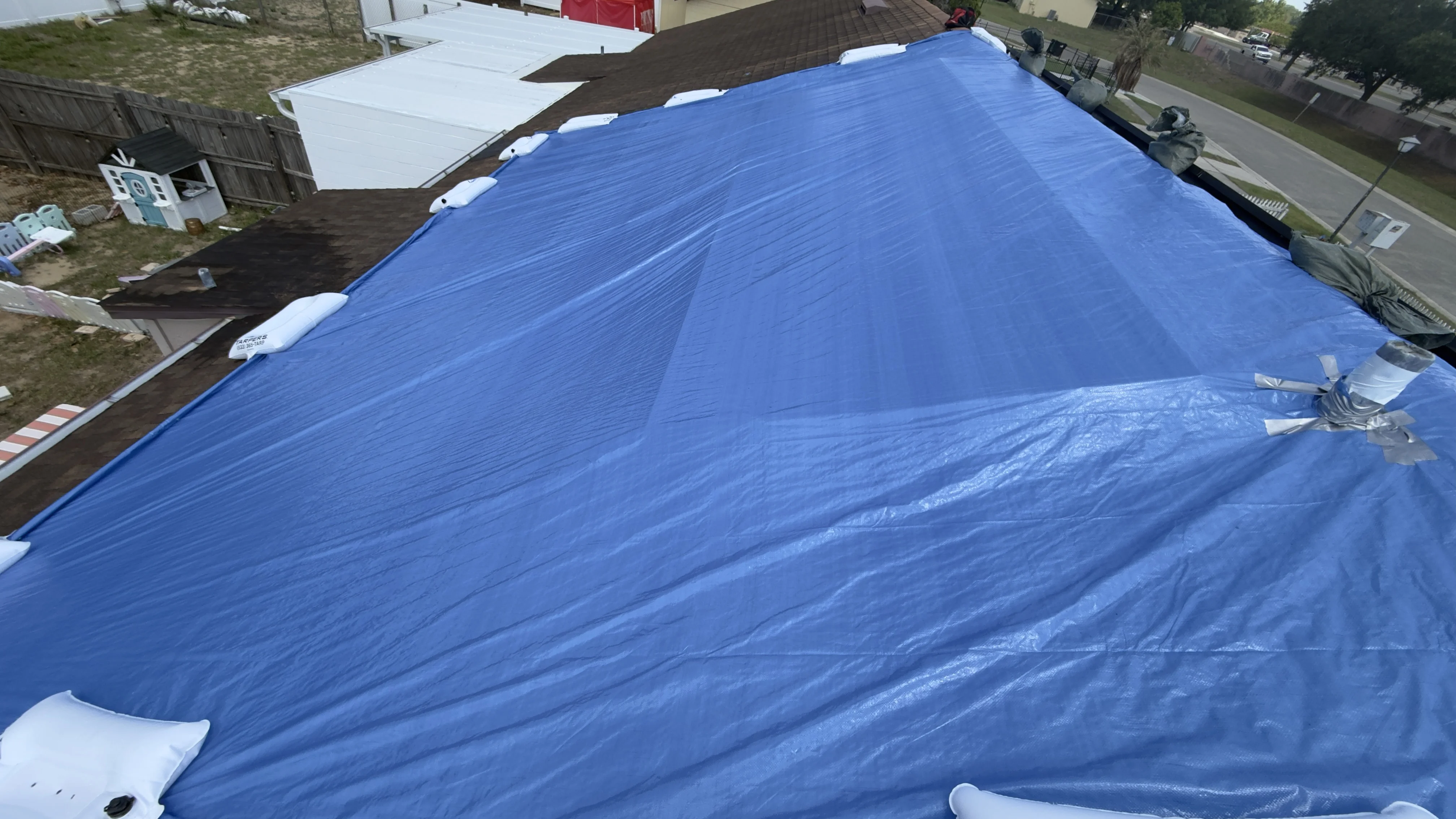
TarpBags® work differently. They're water-fillable bags designed specifically for non-destructive roof tarping. You fill them on-site, position them along tarp edges and ridgelines, and they conform to the roof surface. When the job is done, you drain them and pack them out. No sand residue, no disposal problem, no weight-related handling injury.
Both systems can anchor a tarp without penetrating the roof deck. That's the shared baseline. The differences show up in the details that matter to your file.
Safety and Injury Exposure
This is where the gap is widest. Sandbags weigh between 30 and 50 pounds each. A standard residential tarp job might require 20 or more bags. That's a crew moving 600 to 1,000 pounds of material up a ladder and across a pitched roof, often in post-storm conditions.
The Bureau of Labor Statistics consistently lists roofing among the highest-injury trades. Lifting injuries, falls, and overexertion are the leading causes. When a crew is hauling sandbags, every trip up that ladder is a liability exposure for the contractor and, indirectly, for the carrier managing the claim.
TarpBags® are filled on the roof using a garden hose or water source. A single empty bag weighs under two pounds. Crews carry them up empty and fill them in place. The OSHA manual handling guidelines are far easier to meet when the weight isn't introduced until the bag is already positioned.
For vendor managers and TPAs setting contractor standards, this distinction is worth building into your scope requirements.
Tarp Edge Abrasion and Secondary Damage
Sandbags are rough. The woven polypropylene exterior, combined with the grit of the sand itself, creates a contact surface that abrades whatever it sits on. On a tarp, that means accelerated wear at every contact point. On a roof with existing granule loss or soft spots, it means additional surface damage that wasn't there before the crew arrived.
TarpBags® have a smooth exterior. They distribute weight across a broader contact area and don't introduce abrasive friction. For adjusters writing non-destructive tarping as a covered mitigation method, this matters. The method is only truly non-destructive if the anchoring system doesn't create new damage.
If you're working in Xactware or Symbility and you're pricing a tarping line item, the anchor system affects whether the scope holds up to a re-inspection. A tarp that's been abraded by sandbags may need replacement sooner, which creates a supplement conversation that could have been avoided.
Deployment Speed and Crew Efficiency
Speed matters in emergency tarping. The faster a crew can secure a roof, the less interior damage accumulates. Sandbags require transport, staging, and manual placement. On a two-story home with a steep pitch, that process is slow and physically demanding.
TarpBags® deploy faster because the weight is added after placement. A crew can position all the bags, run a hose, and fill them in sequence. There's no back-and-forth to a staging area. For large commercial roofs or multi-structure losses, the time savings compound quickly.
From a claims management perspective, faster deployment means a shorter window of ongoing water intrusion. That's a direct reduction in total loss cost.
Storage, Transport, and Reuse
Sandbags are single-use in most field applications. Once they've been on a roof, they're contaminated with granules, debris, and moisture. Disposal adds cost and creates a logistics problem for contractors.
TarpBags® are reusable. Drain them, fold them, pack them out. A set of TarpBags® can be used across dozens of jobs before replacement is needed. For contractors managing fleet costs, that's a meaningful difference. For carriers evaluating vendor pricing, it's worth understanding that a contractor using TarpBags® has lower per-job material costs over time, which should be reflected in competitive pricing.
Compliance and Claims Documentation
Non-destructive tarping standards are increasingly referenced in carrier field operations and TPA vendor requirements. The core requirement is that the tarping method must not introduce new penetrations or damage to the roof assembly.
Both sandbags and TarpBags® can meet this standard when applied correctly. The difference is that TarpBags® are purpose-built for this application. The product documentation, the deployment method, and the removal process are all designed around non-destructive tarping. That makes documentation cleaner and re-inspection outcomes more predictable.
If you're a claims manager or carrier field rep reviewing a tarping invoice, a line item that references TarpBags® and non-destructive method is easier to approve and defend than a generic “sandbag anchoring” notation.
| Dimension | TarpBags® | Traditional Sandbags |
|---|---|---|
| Weight and handling | Carried up empty at under two pounds each, then filled with water on the roof, so weight is added only after placement. | Pre-filled at 30 to 50 pounds each and carried up fully loaded, which requires more lifting and staging. |
| Fill method | Filled on site from a garden hose or water source and drained after use. | Filled with sand ahead of time and transported to the job already weighted. |
| Abrasion | Smooth exterior that spreads weight across a broad contact area with minimal friction on the tarp. | Woven exterior and sand grit create a rougher contact surface that can wear the tarp over time. |
| Deployment speed | Bags are positioned first and filled in sequence, reducing trips to a staging area. | Each loaded bag is transported and placed individually, which can take longer on steep or large roofs. |
| Reuse | Drained, folded, and reused across many jobs before replacement. | Often single-use in the field once contaminated with granules and moisture, adding disposal steps. |
| Documentation | Purpose-built product with deployment and removal steps designed around non-destructive tarping. | Widely available and familiar, documented as generic weighted anchoring on the invoice. |
Both TarpBags® and traditional sandbags are valid non-destructive anchor options. The right choice depends on the job, site conditions, and logistics.
What This Means for Your Vendor Standards
If you're setting tarping vendor requirements for a carrier, TPA, or claims management platform, the anchor system is worth specifying. Requiring TarpBags® or equivalent water-fillable anchoring bags in your vendor standards does three things: it reduces crew injury exposure, it eliminates abrasion-related secondary damage, and it makes your non-destructive tarping claims cleaner to document and defend.
Tarpers crews choose between TarpBags® and traditional sandbags based on the job and site logistics, with TarpBags® preferred wherever conditions suit. Our crews are trained on the non-destructive method, and our documentation is formatted for Xactware, Symbility, and CoreLogic platform workflows. If you're building or updating your vendor panel in Florida or the Southeast, we'd like to be on it.
Reach out at (833) 365-TARP or visit our insurance contact page to discuss vendor qualification. You can also review our tarping method documentation or read our sandbags vs nails comparison for more context on anchor system selection.
Partner With Tarpers
Whether you are an insurance carrier, a TPA, or an adjuster looking for reliable non-destructive tarping vendors, we are here to help. Get in touch with our team.