
CAT tarping surge pricing is a real risk after a hurricane, and the strongest protection for a carrier is a tarping vendor whose pricing basis is agreed before the storm and documented on every job. Tarpers is an emergency roof tarping vendor for insurance carriers in Florida, Georgia and other states, working on carrier assignment with itemized job reports and direct invoicing to the carrier.
After a named storm, demand for tarps, labor and lumber jumps within days, and some vendors raise prices to match. Florida law sets limits on how far that can go during a declared state of emergency. Carriers that know the rule, and settle pricing terms with their vendors ahead of time, avoid most of the disputes that follow.
What does Florida law say about surge pricing during a declared emergency?
Section 501.160, Florida Statutes, prohibits selling or renting essential commodities at an unconscionable price within the area under a state of emergency declared by the Governor. The statute defines commodities broadly. It includes goods, services, materials, supplies and equipment needed as a direct result of the emergency, and it names lumber among its examples.
The prohibition runs for up to 60 days under the initial declaration. The Governor can extend it by executive order that specifically references the section.
How does Florida decide whether a price is unconscionable?
The statute compares the price against the 30 days immediately before the emergency was declared. A price is prima facie unconscionable if it shows a gross disparity from the average price of that commodity during that period. It is also prima facie unconscionable if it grossly exceeds the average price at which the same or similar commodity was readily available in the trade area during that period.
Neither test applies when the increase is attributable to additional costs of the sale or rental, or to regional, national or international market trends. Increases approved by an appropriate government agency are not violations either.
Who enforces Florida's price gouging law, and what are the penalties?
The statute names the office of the state attorney and the Florida Department of Legal Affairs as enforcers. The Attorney General's price gouging guide lists civil penalties of $1,000 per violation, up to $25,000 for multiple violations in a single 24 hour period.
The statute adds a separate offense. Offering goods or services to the public during the emergency without the required local business tax receipt is a second degree misdemeanor. Other states set their own rules, so confirm the law in each state where your vendors deploy with that state's attorney general.
Why does CAT tarping surge pricing matter to carriers?
A tarp invoice that cannot be explained line by line slows the file. The adjuster has to work out whether a higher number reflects real cost or opportunism, and that review adds days during the busiest weeks of the year.
Pricing disputes also pull desk adjusters and vendor managers away from new assignments. The cost of surge pricing is not only the invoice. It is the cycle time and staff time spent defending or questioning it. For more on how delays compound, see our post on cycle time benchmarks.
How can carriers reduce surge pricing risk before hurricane season?
Most of the work happens before landfall. Contract language is a matter for your legal team; the steps below cover the operational side.
- Agree on a pricing basis with each tarping vendor before the season, such as the estimating platform line items your desk already uses. Our Xactimate line items reference shows how tarping work is usually written.
- Require itemized invoices that show measurements, materials and photos for every job.
- Use vendors that invoice the carrier directly, so pricing questions go to one accountable company. See why direct carrier invoicing reduces friction.
- Activate vendors with real surge capacity before the season starts, so you are not forced to call unknown contractors at peak demand. Our pre hurricane vendor activation playbook walks through the timing.
- Ask each vendor how it documents material cost increases after a declaration, and keep that answer on file.
What should a carrier ask a tarping vendor about CAT pricing?
Five questions sort most vendors quickly:
- Will you price on the Xactware or Symbility line items we already use?
- Will every invoice include measurements, material costs and before, during and after photos?
- Do you invoice the carrier directly?
- How many assignments have you completed during a single named storm?
- Who does our adjuster call when a number looks wrong?
A vendor that answers all five clearly before the season is far less likely to surprise you after it.
How does Tarpers handle pricing and documentation during a CAT event?
Tarpers works on assignment from insurance carriers, received through Symbility, Xactware, email or phone. Each job report includes before, during and after photos, measurements and material costs, submitted to the carrier's claims system. Tarpers invoices the carrier directly.
That record lets an adjuster check every line against the photos without a reinspection. Details are on our insurance vendors page.
Does surge capacity affect surge pricing?
Yes, indirectly. When a vendor network runs short of crews, carriers end up assigning work to whoever answers the phone, often at whatever price that contractor names. Capacity agreed in advance keeps assignments with vendors whose pricing is already known.
Tarpers has completed 1,000+ tarp assignments across seven named storms, including 475+ assignments in under two months after Hurricane Milton. Crews and materials are staged near the expected impact zone before landfall. Read more on our catastrophe response page and in our post on scaling tarping CAT response.
Does the tarping method affect the final invoice?
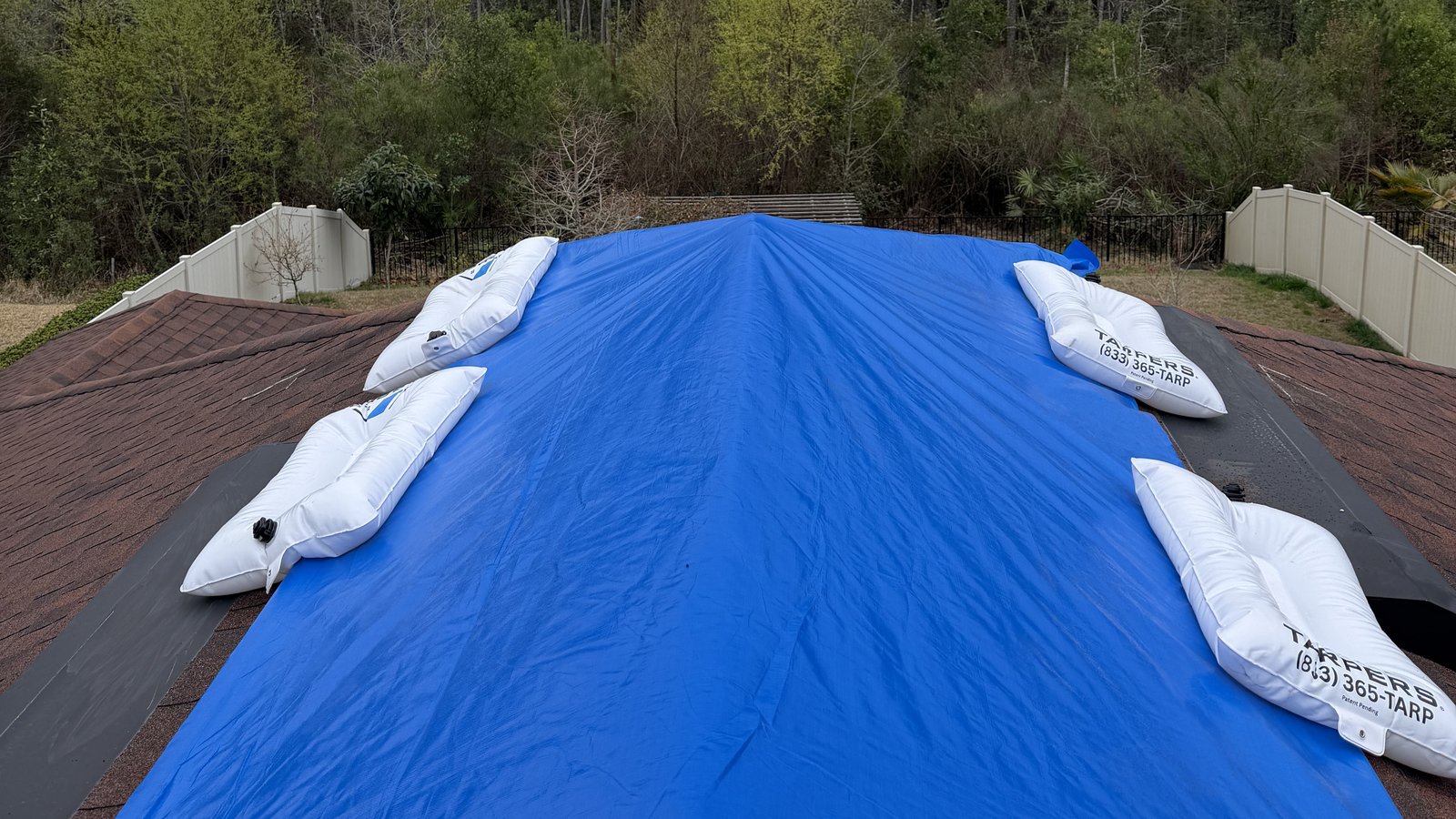
It can. Tarpers never uses nails to secure tarps. Crews anchor with TarpBags® or sandbags, chosen by job and logistics, so the tarp itself does not add roof penetrations that later show up as repair line items on the file.
What should a carrier do if it suspects price gouging?
The Florida Attorney General's guide asks reporters to gather evidence first: estimates, invoices, receipts, advertisements and photos, along with the price charged and the usual price if known. Complaints can be filed through the No Scam app, online at MyFloridaLegal.com, or through the Attorney General's price gouging hotline.
For contractor vetting after a disaster more broadly, the NAIC's 10 things you can do to avoid contractor fraud and abuse recommends written contracts that list each task and the prices for labor and materials.
Bring Tarpers on before the next storm
Pricing surprises are easiest to prevent before a declaration, not after. If you manage vendors for a carrier writing property in Florida or Georgia, talk to our insurance team about adding Tarpers to your program, or contact us with any question.