
Why Xactimate Codes Matter for Emergency Tarping
When a roof claim comes in after a storm, the clock starts immediately. The adjuster needs to document, the vendor needs to mobilize, and the estimate needs to hold up through review. That's where Xactimate line items for emergency tarping become critical. If the codes aren't right, the estimate gets kicked back, the vendor doesn't get paid on time, and the claim drags on longer than it should.
This guide is written for adjusters, estimators, and vendor managers who want a clear, practical reference for the Xactimate codes that apply to emergency roof tarping work. We'll cover the primary line items, how they're measured, and what documentation supports each one.
The Primary Tarping Line Items in Xactimate
The WTR (Water Mitigation) category in Xactimate is where most emergency tarping line items live. The core code you'll use most often is WTR TARPNG, which covers the labor and materials for installing a temporary protective tarp over a damaged roof area.
Here's how the main codes break down:
WTR TARPNG covers the installation of a temporary tarp. It's measured in squares (100 square feet per square), and the unit price includes the tarp material, fastening, and basic labor. This is the workhorse code for most emergency tarping jobs.
WTR TARPNG ADD is the additional charge for steep-slope roofs, typically applied when the pitch exceeds 6:12. Steep-slope work takes more time and carries more risk, so the add-on is appropriate and defensible.
WTR TARPNG REMV covers tarp removal after permanent repairs are complete. Not every carrier includes this in the initial estimate, but it's a legitimate line item and worth including when the scope is clear.
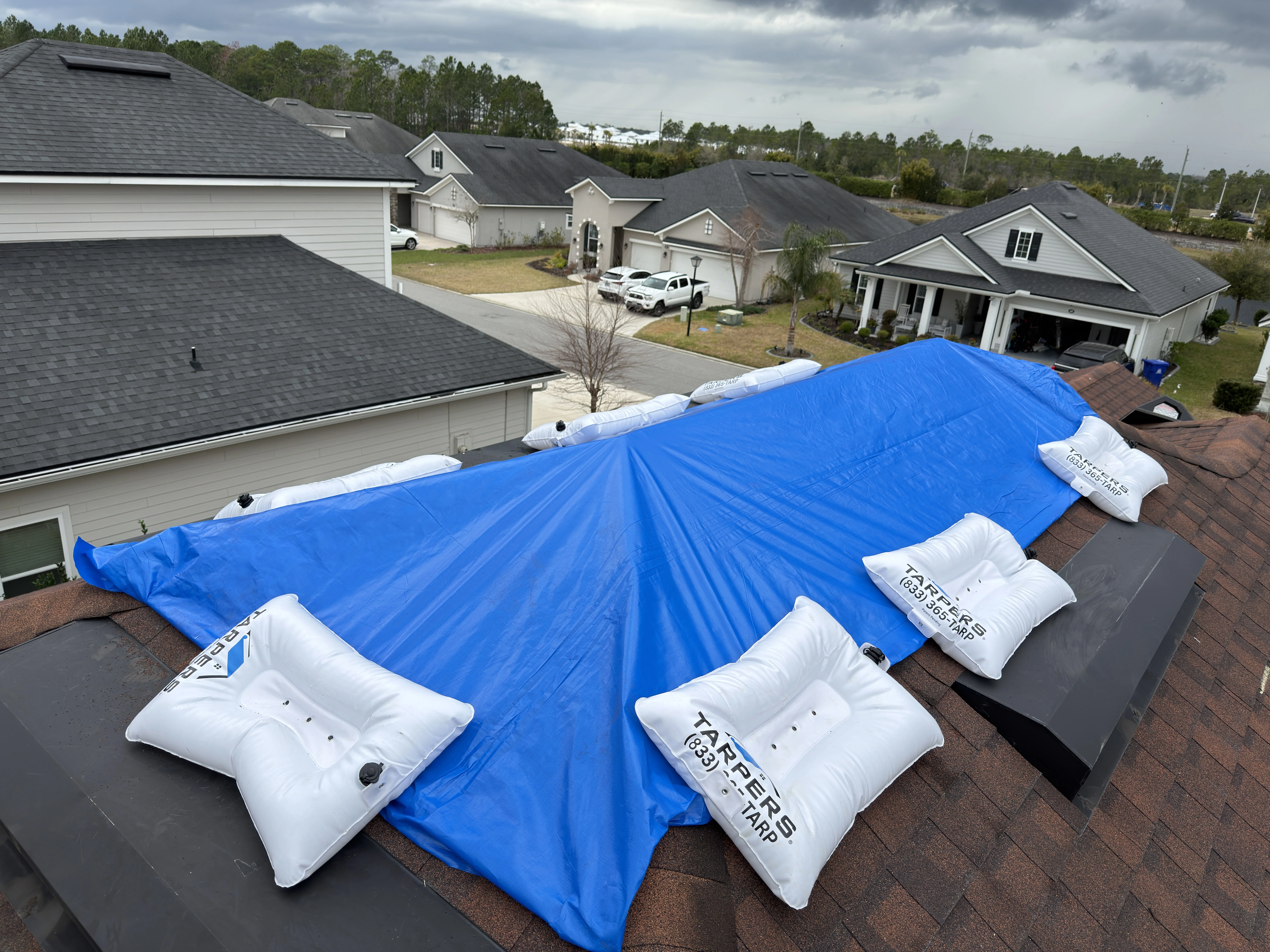
For non-destructive tarping methods, where no fasteners penetrate the roof deck or existing shingles, the labor component may be slightly higher than a standard nail-down installation. That's because non-destructive methods require more time and specialized equipment. The TarpBags® system is one approach that achieves this without creating additional penetrations, which matters for carriers trying to keep the scope of damage clean and well-documented.
Measurement and Documentation Standards
Xactimate line items are only as good as the measurements behind them. For tarping, that means accurate roof area calculations and clear documentation of what was covered.
The standard approach is to measure the affected roof area in squares, then add a reasonable overhang allowance. Most carriers accept a 10 to 15 percent overhang factor for tarps that need to wrap over ridges or extend past eaves to provide adequate protection. Document the measurement method in your notes, whether that's a sketch, aerial measurement, or field measurement.
Photo documentation is non-negotiable. Before-and-after photos of the damaged area, photos of the tarp installation in progress, and a final photo showing the completed installation all support the line items in your estimate. If you're working with a vendor who uses a non-destructive method, photos should also show that no additional fastener holes were created in the roof deck.
For adjusters using Xactware's platform, the sketch tool can be used to outline the tarped area directly on the roof diagram, which creates a clear visual record that ties the measurement to the line item.
Common Estimating Mistakes to Avoid
A few patterns come up repeatedly when tarping estimates get reviewed or disputed.
The first is under-measuring the tarp area. Adjusters sometimes measure only the visibly damaged section and forget that a tarp needs to extend well beyond the damage to provide real protection. A tarp that barely covers the hole isn't doing its job, and a carrier that pays for inadequate protection ends up with a secondary water damage claim.
The second is missing the steep-slope add-on. If the roof pitch qualifies, the add-on is appropriate. Leaving it out undervalues the work and can create friction with the vendor.
The third is failing to document the non-destructive method when it's used. If a vendor installs a tarp without penetrating the roof deck, that's a meaningful distinction for the claim file. It means the scope of damage is limited to what was already there, and the tarp installation itself didn't create new damage. That documentation protects the carrier and the vendor.
For vendor managers working with Tarpers, the job documentation package typically includes timestamped photos, a measurement summary, and a description of the installation method, all formatted to support the Xactimate line items in the estimate.
How Non-Destructive Tarping Affects the Estimate
Non-destructive tarping is increasingly the preferred method for carriers who want to keep the claim scope clean. When a vendor uses a system like TarpBags, the tarp is secured without driving fasteners through the shingles or deck. That means the adjuster doesn't have to account for additional penetration damage when writing the repair scope.
For a full explanation of the non-destructive method and how it differs from nail-down tarping, see How Roof Tarping Works.
From an estimating standpoint, this simplifies the claim. The damage is what it is, the tarp covers it without adding to it, and the repair scope is based on the original storm damage only. That's a cleaner claim file and a more defensible estimate.
The labor cost for non-destructive installation is typically comparable to a standard nail-down installation, sometimes slightly higher for complex roof geometries. But the downstream benefit, avoiding disputes over whether the tarp installation caused additional damage, usually outweighs the marginal cost difference.
Coordinating with Vendors on Xactimate Codes
One of the most common sources of friction between adjusters and tarping vendors is a mismatch between what the vendor invoices and what the adjuster estimated. Getting aligned on Xactimate codes upfront prevents that friction.
When you dispatch a tarping vendor, share the relevant line items you're planning to use. A vendor who knows you're using WTR TARPNG measured in squares will invoice accordingly. A vendor who invoices by the hour or by the tarp size without reference to Xactimate codes creates reconciliation work for everyone.
Tarpers provides documentation formatted to align with standard Xactimate line items, which makes the review process straightforward for adjusters and vendor managers. If you're setting up a vendor panel or evaluating tarping contractors for your carrier or TPA, that kind of documentation alignment is worth asking about upfront.
For cycle time benchmarks that affect estimate timing, see Cycle Time Benchmarks for Emergency Tarping.
For questions about vendor coordination or to discuss insurance partnerships, contact Tarpers at (833) 365-TARP or visit tarpers.com/contact/insurance.
Partner With Tarpers
Whether you are an insurance carrier, a TPA, or an adjuster looking for reliable non-destructive tarping vendors, we are here to help. Get in touch with our team.