
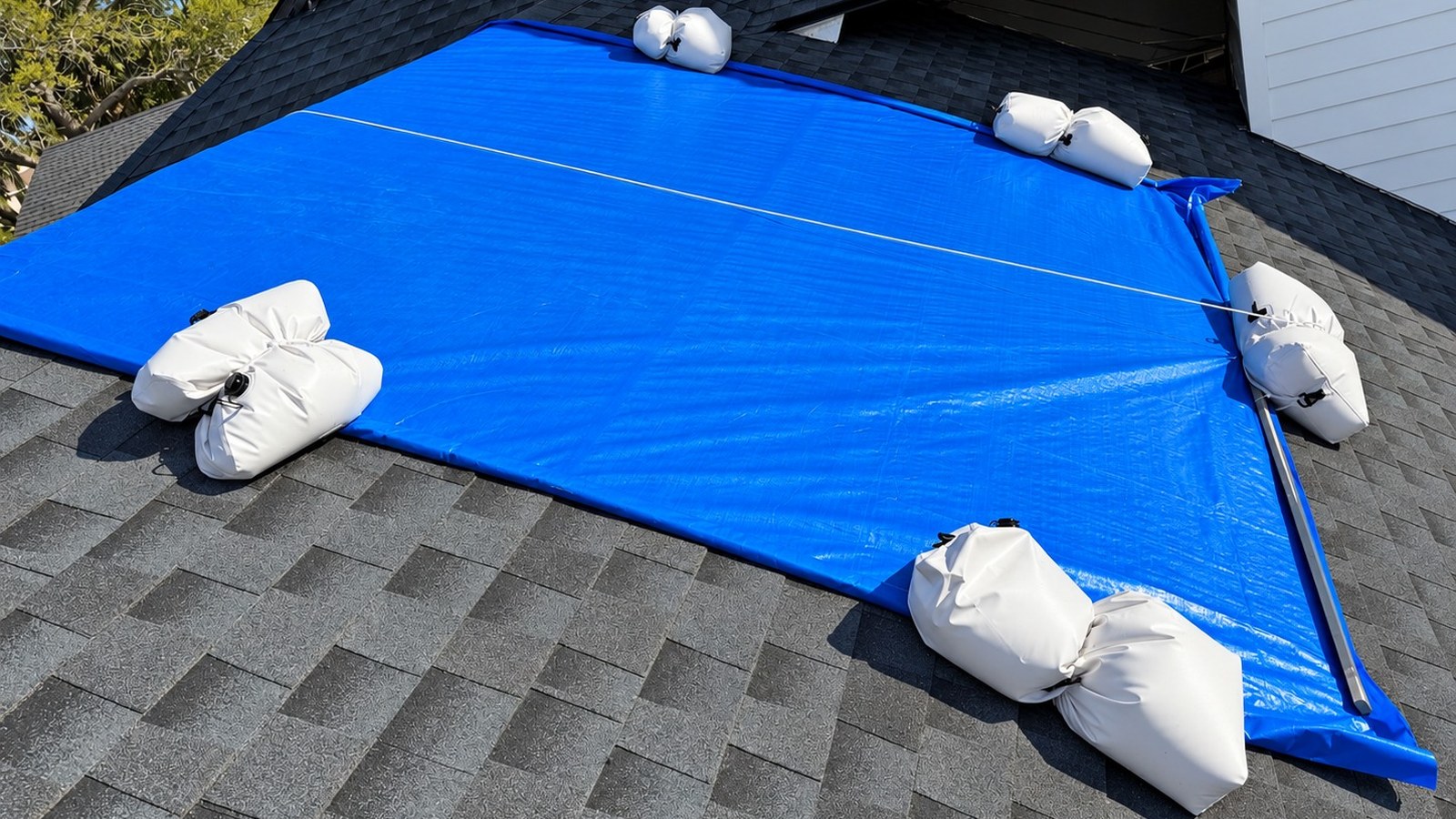
Tarpers is an emergency roof tarping company that installs non destructive roof tarping without nails for insurance carriers in Florida, Georgia and other states. Every Tarpers tarp is held down by weight, using water filled TarpBags® or sandbags placed over furring strips, so nothing is driven through the shingles or the roof deck.
For a claims leader or vendor manager, that one detail changes a lot downstream. A tarp that leaves no new holes in the roof keeps the temporary repair temporary, keeps the file clean, and gives the field adjuster a scope that matches what was there before the crew arrived. This post explains how the method works, when crews choose TarpBags® or sandbags, and what a carrier gets in the job file.
What is non destructive roof tarping without nails?
Non destructive roof tarping means the tarp is secured by weight and friction instead of fasteners. No nails, screws or staples go through the tarp, the shingles or the decking. When the tarp comes off for the permanent repair, the roof is left the way the storm left it, with no added penetrations to find, document or price.
Nail down tarping does the opposite: every fastener is a new hole in a roof that is already damaged. Our post on the hidden cost of nail down roof tarping walks through why that matters for claim files.
How does Tarpers anchor a tarp without nails?
Tarpers follows the same sequence on every job, described in full on our How It Works page:
- Inspect and photograph the damaged area before any work begins.
- Lay a UV resistant, reinforced polyethylene tarp, at least 10 mil thick, over the damage and past the ridge line and eaves so water runs off the covered area instead of under the edge.
- Lay furring strips of 1x4 or 2x4 lumber around the perimeter at 4 to 6 foot intervals to spread the holding force along the edges.
- Place weighted anchors, TarpBags® or sandbags, along the strips, edges and seams.
- Photograph the finished installation and record the method and measurements.
The weight sits on the furring strip, and the strip holds the tarp edge flat along its full length. Our guide to furring strip anchoring covers what a quality perimeter looks like.
What are TarpBags®?
TarpBags® are a water filled anchoring system built for emergency roof tarping. Crews carry them up to the roof empty and fill them on site with water, so no one has to haul heavy material up a ladder. Filled, each bag weighs 40 to 50 pounds. When the job is done they can be drained, folded and reused.
The smooth exterior is meant to rest on the strip and tarp without grinding at them. TarpBags® were featured in Insurance Journal and won top prize at the 2026 Volusia Innovation Challenge.
When do crews use sandbags instead?
Sandbags are a valid non destructive anchor, and Tarpers crews still use them. The choice between TarpBags® and sandbags is made job by job, based on the roof, the site, access and logistics during a storm surge. Both anchor the tarp without penetrating the deck.
The trade offs are practical. Sandbags must be carried up full, typically 30 to 50 pounds each, while TarpBags® go up empty and are filled on the roof. For a side by side look at handling, abrasion, speed and reuse, see TarpBags® vs sandbags for insurance roof tarping.
Can non destructive tarping work on tile, metal and slate roofs?
Yes, and those are the roofs where it matters most. Tile, metal and slate cannot take nail penetrations without new damage, so a weighted anchor system is the practical way to tarp them. Tarpers uses the same furring strip and weighted anchor sequence on these roofs as on shingles. Our post on tile vs shingle roof tarping explains the differences crews plan for.
What does a carrier get in the job file?
Every Tarpers job package is built for the claim, not just the crew. It includes:
- Timestamped photos before, during and after the installation.
- A measurement summary, including the overhang factor.
- A written description of the installation method, formatted for Xactimate line items.
- A record that the installation was non destructive.
Tarpers works with Xactware and Symbility assignments and invoices the carrier directly. Details are on our insurance vendors page.
Does non destructive tarping slow down catastrophe response?
No. The method is designed for volume. Because TarpBags® go up empty and are filled on the roof, crews avoid hauling hundreds of pounds of sand per job, and the steps are the same on every roof, which keeps quality consistent from crew to crew.
Tarpers has completed 1,000+ tarp assignments across seven named storms, including 475+ assignments in under two months after Hurricane Milton. Our catastrophe response page explains how we deploy when a named storm hits, and our completed projects page shows the work.
How long does a non destructive tarp hold?
It depends on the roof, the season and the weather, and an emergency tarp is always a temporary repair. Tarpers does not promise a set number of months. The permanent repair should be scheduled as soon as possible, and crews document the installation so the next contractor knows exactly what is on the roof.
Why does this matter during hurricane season?
The Atlantic hurricane season runs from June 1 to November 30, according to the National Hurricane Center. After a named storm, a carrier can need a large number of roofs tarped quickly. A vendor that uses one non destructive method on every roof gives the claims team the same photo set, the same method description and the same clean roof on every file, which makes those files easier to review and close.
How can a carrier add Tarpers as a vendor?
Tarpers works on assignment from insurance carriers and serves Florida statewide from our South Daytona headquarters, along with Georgia and other states. Vendor managers and claims leaders can reach us through our insurance contact page to set up assignments, or through our general contact page with any question about non destructive roof tarping without nails.