
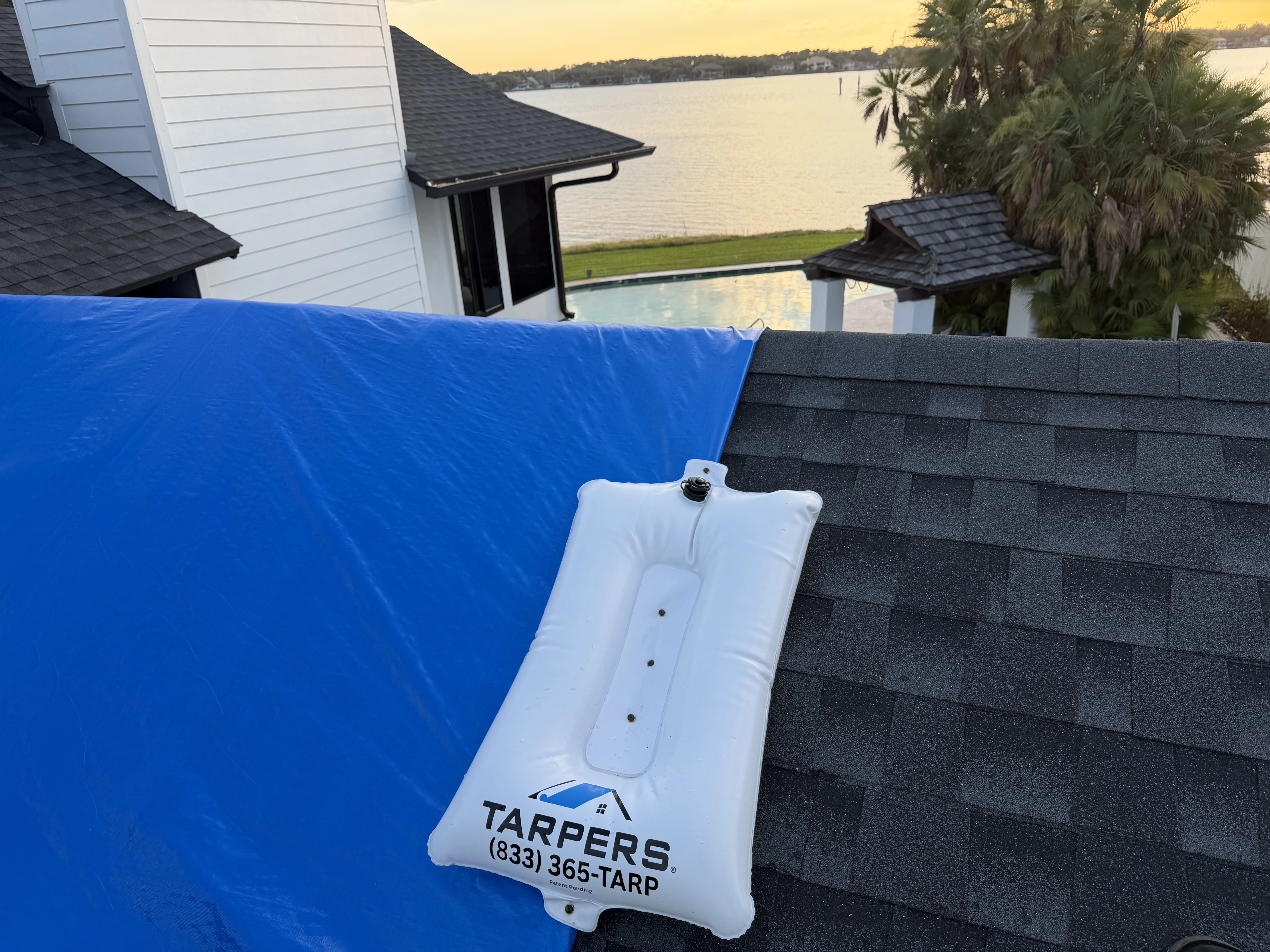
Nail-down tarping is the default. It has been for decades. A crew shows up after a storm, drives nails through a tarp and into the shingles, and moves on to the next property. The roof is covered. The claim file gets a note. Everyone moves on.
Except the roof does not move on. And six to eighteen months later, neither does the carrier.
The real cost of nail-down tarping is not the tarp. It is not even the labor. It is the supplemental claim cycle that starts the moment a nail punches through a shingle and creates a penetration point that no one seals. Water finds those holes. It always does. And when it does, the original storm claim reopens, the adjuster goes back out, and the carrier absorbs a loss that was entirely preventable.
This is not a fringe scenario. It is a pattern that shows up across books of business in Florida, the Carolinas, Georgia, and every other state where convective storms and hurricanes drive high-volume emergency tarping activity.
What Nail Penetrations Actually Do to a Claim
When a crew drives nails through a tarp, they are creating new roof penetrations on a structure that is already compromised. The tarp itself may hold for weeks or months. But the nails do not seal when the tarp comes off. The holes remain. If the roof replacement is delayed, or if the tarp shifts, those penetrations become active leak points.
The damage that follows is often categorized as a new loss event. That means a new adjuster visit, a new estimate, and a new round of negotiations over scope. In Xactware and Symbility workflows, the supplemental gets filed, the line items get disputed, and the cycle extends. What should have been a clean, single-event claim becomes a multi-touch file that costs more to administer than it does to pay.
Adjusters who work high-volume catastrophe assignments see this pattern regularly. The original storm damage is documented. The tarp goes on. Then, months later, the property owner calls back with new water intrusion. The adjuster has to determine whether the new damage is storm-related or vendor-related. That determination takes time, creates friction, and often results in a payment that the carrier did not price into the original reserve.
The Supplemental Claim Cycle in Numbers
The direct cost of a supplemental claim varies by market and scope, but the administrative cost is consistent. Every reopened file requires adjuster time, documentation, and often a second estimate. In high-volume catastrophe markets, that overhead compounds quickly.
Carriers managing large books of business in storm-prone states are not dealing with one or two supplemental claims from nail-down tarping. They are dealing with a percentage of every tarped property that was handled with the nail-down method. If that percentage is even five percent of a large CAT deployment, the aggregate cost is material.
The non-destructive tarping method eliminates this exposure at the source. No nails means no new penetrations. No new penetrations means no vendor-introduced leak points. The claim stays clean, the file closes, and the carrier does not hear from that property again until the next storm.
How Non-Destructive Tarping Changes the Math
TarpBags® replace nails as the anchoring method for emergency roof tarps. Crews carry empty bags up the ladder, position them along the furring strips that hold the tarp edges, and fill them with water from a standard garden hose on the roof. The filled bags create distributed weight along the tarp perimeter without penetrating the roof surface.
The result is a tarp that holds without introducing new damage. When the tarp comes off, the roof is in the same condition it was in when the crew arrived. The original storm damage is documented. The repair scope is clean. The claim closes without a supplemental.
For carriers and TPAs that use Symbility or Xactware for estimate management, the documentation difference is significant. A roof that has been protected non-destructively produces a cleaner scope at the adjuster site visit. There are no nail holes to account for, no vendor-introduced damage to separate from storm damage, and no ambiguity about what caused what.
Across storm-affected markets, secondary damage events are a well-documented driver of a disproportionate share of total claim cost. Non-destructive tarping addresses one of the most common sources of that secondary damage before it starts.
What This Means for Vendor Selection
Carriers and TPAs that route emergency tarping work through preferred vendor networks have direct influence over which methods get used in the field. Specifying non-destructive tarping as a requirement for preferred vendor status is a straightforward way to reduce supplemental claim exposure across an entire book of business.
Tarpers operates with TarpBags® as the standard anchoring method across its crews in Florida and the Southeast. The system is field-tested and designed to integrate with the documentation workflows that carrier and TPA partners already use. Crews are trained on the method, and the results are consistent across property types and roof configurations.
For adjusters working individual files, the ask is simpler: when you are assigning emergency tarping work, ask whether the vendor uses a non-destructive method. The answer tells you a lot about what the claim file is going to look like six months from now.
The Carrier-Side Case for Non-Destructive Tarping
The argument for non-destructive tarping is not primarily about being careful with roofs. It is about claim economics. Nail-down tarping creates a predictable downstream cost that carriers absorb without always connecting it back to the original vendor decision. Non-destructive tarping removes that cost from the equation.
The math is not complicated. Fewer supplemental claims mean lower total claim cost. Lower total claim cost means better loss ratios on storm-affected books. Better loss ratios mean more capacity to write business in markets that need it.
Tarpers is building the vendor infrastructure to support carrier and TPA partners who want to move their preferred vendor networks toward non-destructive methods. If you are managing a book of business in Florida or the Southeast and you want to talk through what that looks like operationally, contact the Tarpers insurance partnerships team or call (833) 365-TARP.
You can also learn more about the TarpBags® system and how it fits into the claims workflow your adjusters are already using. The non-destructive tarping method page covers the field process in detail, including how crews deploy and document the work for carrier review.
The supplemental claim cycle from nail-down tarping is a known cost. It does not have to be a permanent one.
Partner With Tarpers
Whether you are an insurance carrier, a TPA, or an adjuster looking for reliable non-destructive tarping vendors, we are here to help. Get in touch with our team.