
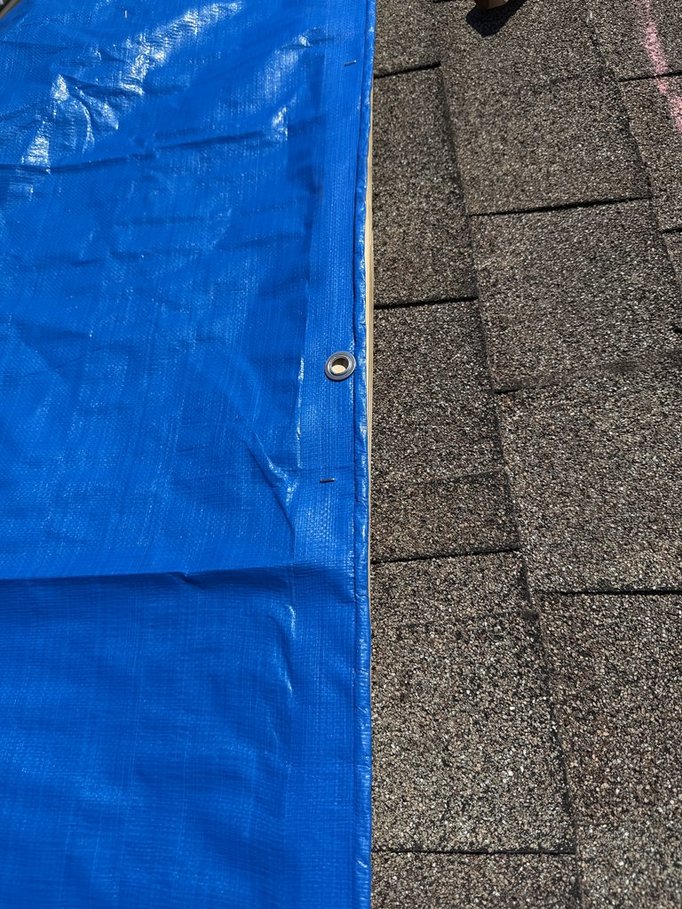
When you pull up to a storm-damaged property and see a tarp on the roof, the first question most adjusters ask is whether the temporary protection is going to hold. The second question, which often does not get asked until months later, is whether the installation created new damage in the process. Furring strip anchoring is the method that answers both questions correctly. Here is what it looks like, why it works, and what you should be checking for when you document a tarped roof.
What Furring Strip Anchoring Actually Is
A furring strip is a length of dimensional lumber, typically a 1x4 or 2x4, laid flat across the edge of a tarp. The strip runs along the perimeter of the tarp where wind lift is most likely to occur. Instead of driving nails through the tarp and into the roof deck, the crew secures the tarp by weighting the furring strip down from above.
The weight distribution is the key. A single nail point concentrates stress at one spot. A furring strip spreads that load across the full length of the tarp edge. When wind gets under a tarp, it does not push at one point. It pushes across the whole surface. Furring strips match that load profile in a way that nail penetrations simply cannot.
The anchoring weight on top of the furring strip can be TarpBags®, which are water-fillable anchor bags that crews carry up empty and fill on the roof from a standard garden hose. No heavy lifting at height. No sandbags. The bags sit on top of the furring strip and hold it down without touching the roof surface at all.
Why Nail-Down Tarping Creates Downstream Claims
Nail-down tarping is still common, and it is worth understanding exactly why it creates problems for carriers and adjusters. When a crew drives nails through a tarp and into shingles, those penetrations do not seal. The tarp may hold for weeks or months, but the holes remain. Water finds them.
Six months after the original storm, a property owner files a supplemental claim for interior water damage. The adjuster goes back out. The roof has new leak points that were not there before the tarp went on. Determining what is storm damage and what is vendor-introduced damage becomes a documentation problem, a coverage dispute, and sometimes a litigation problem.
Non-destructive tarping using furring strips eliminates that failure mode entirely. There are no nail holes. The roof surface under the tarp is the same after removal as it was before installation. That matters for Xactware scoping, for Symbility documentation, and for any carrier that wants a clean claim file without secondary loss complications.
What a Quality Furring Strip Installation Looks Like
When you are documenting a tarped property, here is what a properly executed furring strip installation should show:
The tarp should extend past the ridge and down both sides of the roof, with the edges folded back over the furring strips rather than cut short. The furring strips should run continuously along the tarp edge, not in short sections with gaps. The anchoring weight should sit on top of the furring strip, not beside it or underneath it.
The tarp surface should be taut. A loose tarp flaps in wind, and flapping creates abrasion against the shingles and eventually tears the tarp at the anchor points. A properly weighted furring strip installation keeps the tarp flat and under consistent tension.
There should be no nail holes visible in the tarp or in the shingles along the tarp perimeter. If you see nail heads, the installation is not non-destructive regardless of what the vendor calls it.
How This Fits Into Claims Workflow
For adjusters working in Symbility or Xactware, documenting a non-destructive tarp installation is straightforward. The roof surface is intact. The tarp is a temporary protective layer. Removal is clean. There is no repair scope for vendor-introduced penetrations because there are none.
For carrier field ops and TPAs managing vendor networks, the furring strip method is also easier to quality-control at scale. The visual indicators of a proper installation are clear. Crews either ran continuous furring strips with adequate anchoring weight or they did not. That is a faster audit than trying to assess whether nail penetrations were placed correctly or whether they will cause problems later.
Non-destructive tarping using furring strips and TarpBags® is the method Tarpers uses across its Florida and Southeast operations. It is the same approach that Insurance Journal covered in May 2026 as a meaningful shift in how the industry approaches emergency roof protection.
Wind Resistance and Edge Protection
The tarp edge is where failures happen. Wind gets under the edge, lifts the tarp, and once it starts moving, the whole installation can fail within minutes. Furring strips address this directly by creating a weighted, rigid edge that wind cannot easily get under.
The weight distribution also matters for the roof surface itself. A furring strip spreads the anchoring load across the full length of the tarp edge. That means no concentrated stress points on the shingles, no localized compression damage, and no new repair scope introduced by the anchoring method.
For properties in Florida and the Southeast where wind events are frequent and sometimes prolonged, this is not a minor detail. A tarp that fails during a second weather event after the original storm creates a much more complicated claim than one that holds through the full temporary protection period.
What Adjusters Should Ask Vendors
If you are working with a tarping vendor and want to confirm they are using a non-destructive method, the questions are simple. Ask whether they use furring strips. Ask what they use for anchoring weight. Ask whether any nails or fasteners penetrate the tarp or the roof surface.
A vendor using TarpBags® and furring strips can answer all three questions clearly. The installation is documentable, the method is auditable, and the claim file stays clean.
To learn more about how Tarpers approaches non-destructive tarping for insurance claims, visit our TarpBags® product page or review our guide on sandbags vs. nails. For carrier and TPA partnerships, reach out through our insurance contact page or call (833) 365-TARP.
Partner With Tarpers
Whether you are an insurance carrier, a TPA, or an adjuster looking for reliable non-destructive tarping vendors, we are here to help. Get in touch with our team.