
The first 72 hours storm response window decides how many damaged roofs get covered before interior water damage spreads. Tarpers is an emergency roof tarping company that works on assignment from property insurance carriers in Florida and Georgia, and the carriers that move fastest after landfall are the ones whose tarping vendor was already staged, already briefed and already reporting before the first assignment arrived.
This guide is written for claims leaders, vendor managers, carrier field ops and TPAs. It walks through the dispatch sequence, the communication cadence and the hand offs that keep a storm response first 72 hours from turning into a backlog.
What happens before landfall sets up the first 72 hours?
The 72 hour clock really starts days earlier. According to the National Hurricane Center glossary, a hurricane watch is issued 48 hours before tropical storm force winds are expected, and a hurricane warning 36 hours before, because preparation gets difficult once those winds arrive. Those two notices are the practical triggers for vendor activation.
On the Tarpers side, the catastrophe response process begins with event monitoring, then moves to pre deployment staging: teams and equipment are placed near the expected impact zone, in safe locations, so the drive in after the storm is short. Crews carry their own equipment and materials, so the first day does not depend on local supply in a damaged area.
What the carrier can do in that same window:
- Confirm which vendors are activated and for which regions.
- Name one contact on each side for assignments, escalations and daily reporting.
- Agree on the intake channel, whether Xactware, Symbility, email or phone.
- Share the photo and report standard the desk expects on every file.
Our pre hurricane vendor activation playbook covers the months before the season. The steps above are the last 48 hours before the wind.
Hours 0 to 24: how should post landfall vendor activation work?
Once conditions are safe, crews enter the affected area and begin emergency tarping. Tarpers teams mobilize within hours of a catastrophic event declaration, and when an assignment arrives, Tarpers contacts the property owner within hours to schedule service.
The most useful thing a carrier can do in the first day is release assignments as soon as they are triaged, not in a single large batch at the end of the day. A steady flow lets a vendor route crews by area instead of crossing a damaged region twice. Priority flags help too: an open roof over occupied living space, or a structure with water already coming in, should go to the top of the list.
Day one is also when access problems show up. Road closures, downed lines and restricted zones change hour by hour, so the vendor should report which areas it can and cannot reach, and the carrier should know before an adjuster sends a policyholder an expected arrival time.
Hours 24 to 48: what communication cadence keeps a CAT response on track?
By the second day, volume is building and the risk shifts from speed to visibility. A desk that cannot see which roofs are tarped, which are scheduled and which are blocked starts making duplicate calls, and duplicate calls slow everyone down.
A simple cadence works better than constant check ins. One status report at the start of the day and one at the end, each listing completed jobs, scheduled jobs and any job that cannot be done with the reason. Escalations go to the named contact as they happen. Our post on daily communication cadence goes deeper on what that report should hold.
Documentation has to keep pace from the start. Tarpers photographs every job before, during and after the install and submits a report with photos, measurements and material costs to the carrier's claims system. When files arrive complete on day two, reviewers are not chasing photos on day ten. See our photo documentation standards for what a complete file includes.
Hours 48 to 72: how does an immediate CAT response turn into sustained operations?
By the third day, the question is whether the pace can hold. Tarpers maintains operations until the immediate protection needs are met, with additional crews rotating in as needed to keep service levels steady. Crews work dawn to dusk, 7 days a week, through the event.
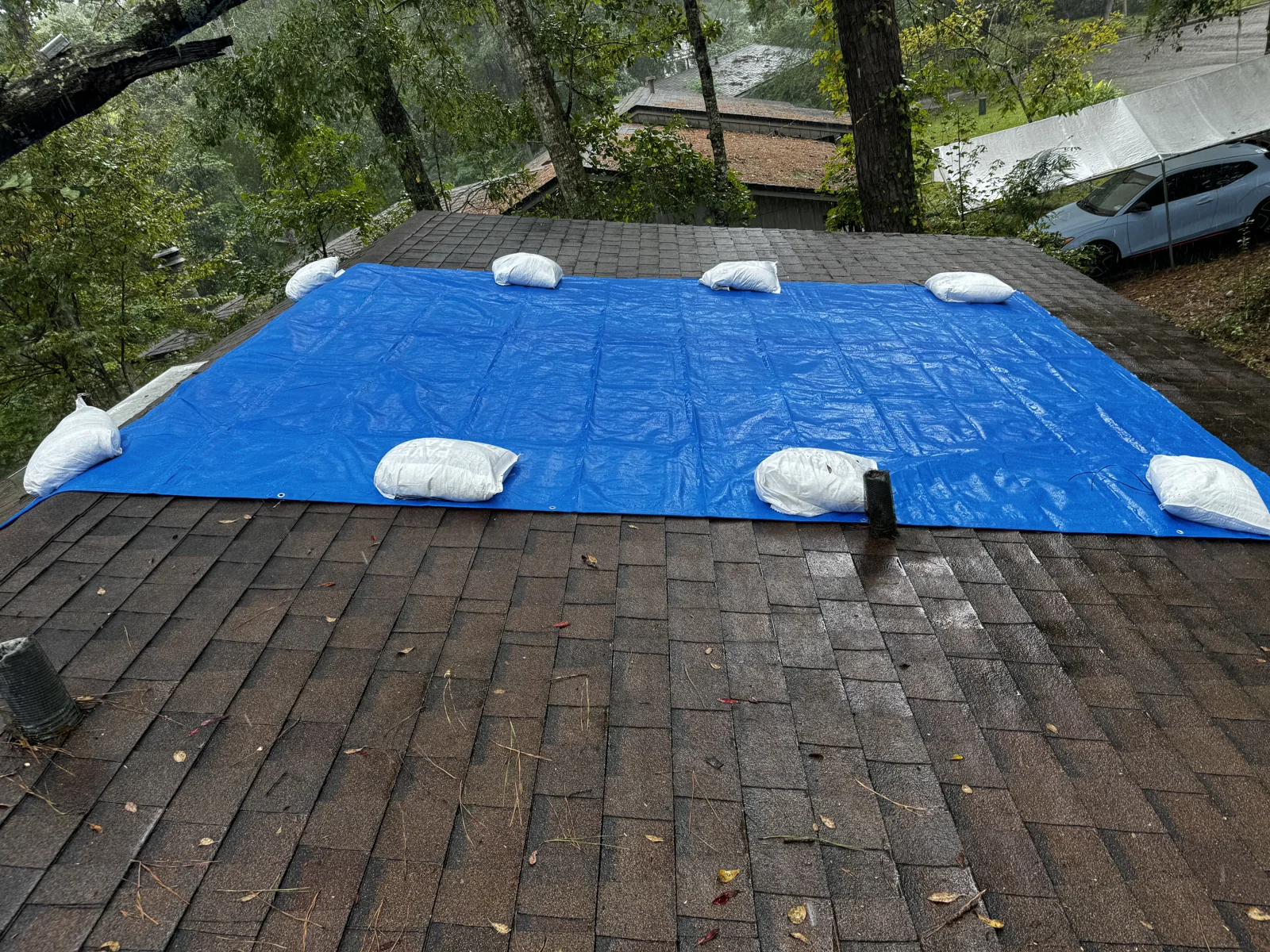
Quality has to hold with the pace. Tarpers uses a non-destructive method that anchors tarps with TarpBags® or sandbags, chosen by the job and the logistics, so no new nail holes are added to a roof that is already damaged. The same method on every roof means the first install and the five hundredth look the same at review. The emergency tarping page describes the install itself.
Day three is also the right time to set expectations with policyholders. An emergency tarp is a temporary fix. Depending on the roof, the weather and the install, it lasts weeks to a few months, and it varies case by case. Permanent repair still needs to be scheduled promptly.
What can carriers learn from vendors that have done this at scale?
Tarpers has completed 1,000+ tarp assignments across seven named storms, including 475+ assignments in under two months after Hurricane Milton. The lesson from that work is that the first 72 hours are mostly decided by what was agreed before the storm: who is activated, how assignments flow, what the daily report looks like and how billing works. Tarpers invoices the carrier directly, so billing never sits between the tarp and the file.
After each named storm, an after action review is worth the hour it takes. Industry groups such as PLRB maintain catastrophe and weather resources for member carriers, and comparing your own response timeline against what worked and what stalled is how the next first 72 hours gets shorter. You can see examples of Tarpers work on our completed projects page, and the operations side of moving crews between states in multi state CAT deployment.
If you are planning vendor capacity for the next event, start on our insurance contact page or the main contact page.
Plan Your First 72 Hours With Tarpers
Tarpers works with carriers, TPAs and adjusters on non-destructive emergency tarping in Florida and Georgia. Call (833) 365-TARP or reach our insurance team online.