
When a roof tarp fails, the original storm damage is no longer the only number on the claim. Interior water intrusion compounds fast. Drywall absorbs moisture within hours. Insulation loses its R-value and becomes a moisture substrate. Flooring buckles. Contents get soaked. And if the property sits unaddressed for more than 48 to 72 hours, interior remediation moves from a possibility to a near-certainty. For adjusters and carrier field ops, understanding what secondary water damage actually costs, in concrete terms, is the difference between a well-reserved claim and a supplement spiral.
This post breaks down the cost categories that emerge when emergency tarping fails, the square-footage math that drives those numbers, and what non-destructive tarping methods do to reduce that exposure.
Why Tarp Failures Drive Interior Loss
Not all tarp failures are equal. A tarp that blows off in a second wind event is a different problem than a tarp installed with nail penetrations that slowly leak for weeks. Both produce interior damage, but the nail-down failure is particularly costly because it is invisible. The property owner may not notice water intrusion until drywall is already saturated, and by then the remediation scope has expanded well beyond what the original storm caused.
The pattern is well-documented in the field: a nail-down tarp introduces new penetration points into a roof that was already compromised. Water finds those points. It tracks along rafters, pools in ceiling cavities, and wicks into wall assemblies. The claim that started as a wind event becomes a water damage claim with a secondary damage rider.
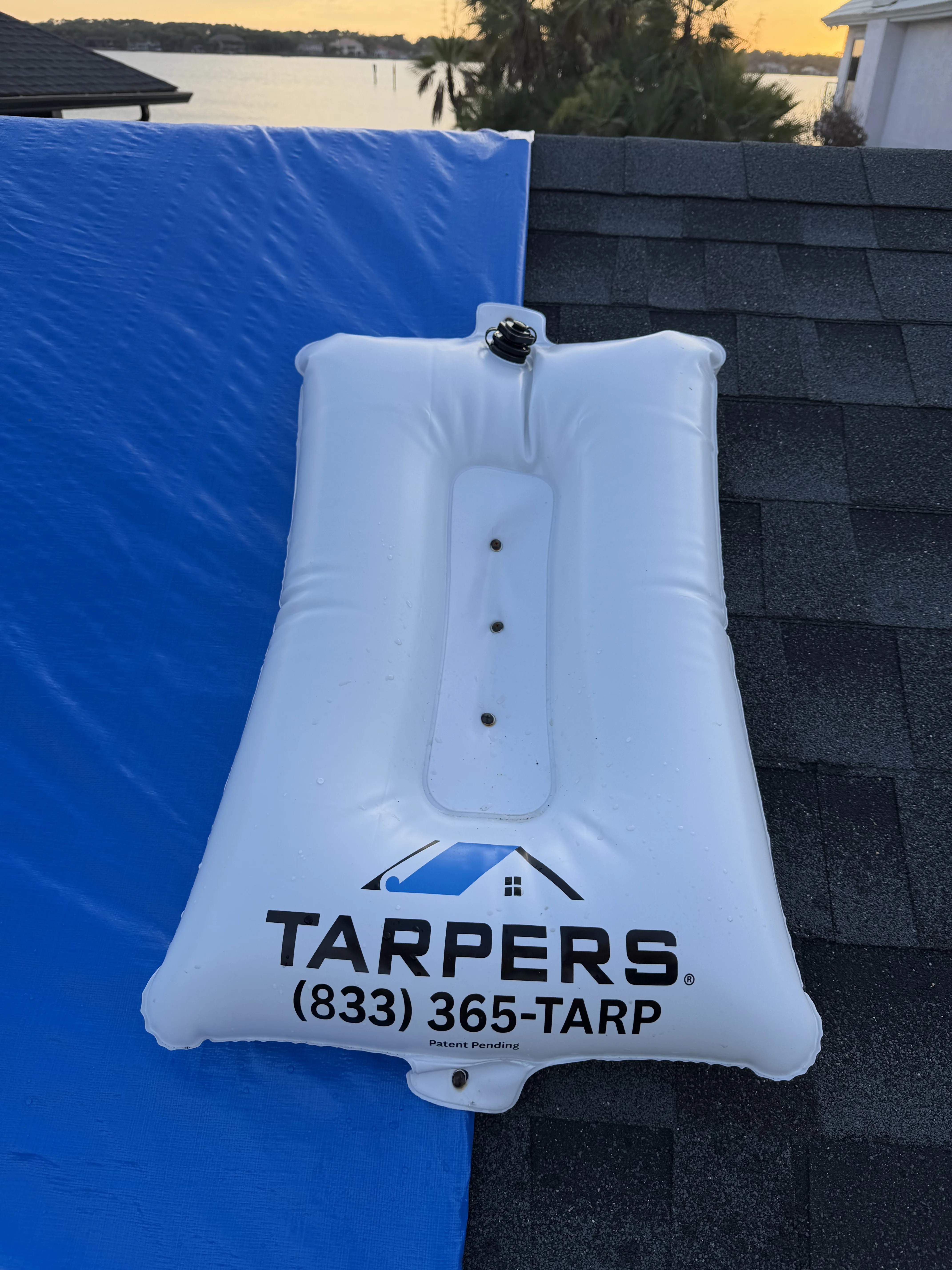
Non-destructive tarping, using a system like TarpBags® that anchors without penetrating the roof surface, eliminates that failure mode entirely. No new holes means no new leak paths.
The Cost Categories That Compound
When interior water intrusion occurs after a tarp failure, adjusters typically encounter four cost categories that stack on top of the original storm damage.
Drywall and ceiling replacement. Water-saturated drywall cannot be dried in place once it has been wet for more than 24 to 48 hours. Industry restoration pricing for drywall removal, disposal, and replacement runs roughly $3 to $6 per square foot for standard residential assemblies. A single room with a compromised ceiling can add $1,500 to $4,000 to the claim scope before any other category is touched.
Insulation removal and replacement. Fiberglass batt insulation that gets wet loses its thermal performance and becomes a moisture retention medium. Blown-in cellulose is worse: it compacts, retains moisture, and is difficult to dry. Removal and replacement of attic insulation runs $1.50 to $3.00 per square foot of attic floor area. For a 1,500-square-foot attic, that is $2,250 to $4,500 added to the claim.
Flooring remediation. Hardwood floors that absorb water buckle and cup. Laminate delaminates. Even tile can be affected when the subfloor beneath it gets wet. Flooring replacement costs vary widely by material, but $4 to $12 per square foot is a reasonable range for common residential finishes.
Interior remediation. This is the category that most dramatically changes claim economics. Once secondary damage is confirmed, the scope expands to include containment, air scrubbing, antimicrobial treatment, and often additional drywall and framing removal. The IICRC S500 standard for water damage restoration provides the industry framework for categorizing and scoping this type of loss. Interior remediation in a residential setting commonly runs $15 to $30 per square foot of affected area. A modest event in a single room can add $3,000 to $8,000 to the claim. A larger event involving multiple rooms or HVAC contamination can push well past $20,000.
Running the Numbers on a Typical Claim
Consider a scenario adjusters encounter regularly: a 2,000-square-foot Florida home with storm damage to 400 square feet of roof decking. A nail-down tarp is installed. Over the following three weeks, water tracks through the nail penetrations into the attic and down into two bedrooms and a hallway.
The original storm damage estimate: $18,000 to $22,000 for roof repair and decking replacement.
The secondary damage from tarp failure, using mid-range figures:
- Drywall in two bedrooms and hallway (approximately 600 square feet): $2,400 to $3,600
- Attic insulation over affected area (approximately 500 square feet): $750 to $1,500
- Bedroom flooring (approximately 400 square feet of laminate): $1,600 to $4,800
- Interior remediation (two rooms, moderate scope): $6,000 to $12,000
Total secondary damage: $10,750 to $21,900. That is a claim that nearly doubles in scope because of how the temporary protection was installed.
What Non-Destructive Tarping Changes
The math above assumes a tarp failure caused by nail penetrations. A non-destructive installation using TarpBags® removes that failure mode from the equation. The tarp is anchored with water-filled bags along the furring strips, with no penetrations into the roof surface. The temporary protection phase of the claim does not introduce new leak paths.
For carriers and TPAs, the practical impact is a claim that stays closer to its original reserve. The roof repair scope remains the roof repair scope. Interior damage stays limited to what the storm actually caused, not what the vendor introduced during mitigation.
You can read more about how the non-destructive method works on our tarping method page, and see how nail-down tarping creates secondary damage in our post on roof tarp damage from nails.
What Adjusters and Vendor Managers Should Ask
When reviewing a claim where secondary water damage appeared after emergency tarping, a few questions help isolate the cause. Was the tarp installed with nails or mechanical fasteners? If yes, the penetrations are a likely contributor to any interior water intrusion that developed after installation. How long was the tarp in place before the interior damage was discovered? Nail-induced leaks often take two to four weeks to produce visible interior symptoms.
Does the vendor's documentation include photos of the installation method? A non-destructive installation should show furring strips, bag anchoring, and no nail guns. Tarpers documents every installation with timestamped photos that show the non-destructive method, the TarpBags® anchoring system, and the condition of the roof surface before and after. That documentation is available to adjusters and carrier partners on request.
Secondary water damage from failed emergency tarping is not an inevitable part of the claims process. It is a predictable outcome of a specific installation method, and it is preventable. To discuss vendor qualification standards, carrier-direct programs, or how Tarpers integrates with Symbility and Xactware documentation workflows, contact the Tarpers insurance partnerships team or call (833) 365-TARP.
Partner With Tarpers
Whether you are an insurance carrier, a TPA, or an adjuster looking for reliable non-destructive tarping vendors, we are here to help. Get in touch with our team.