
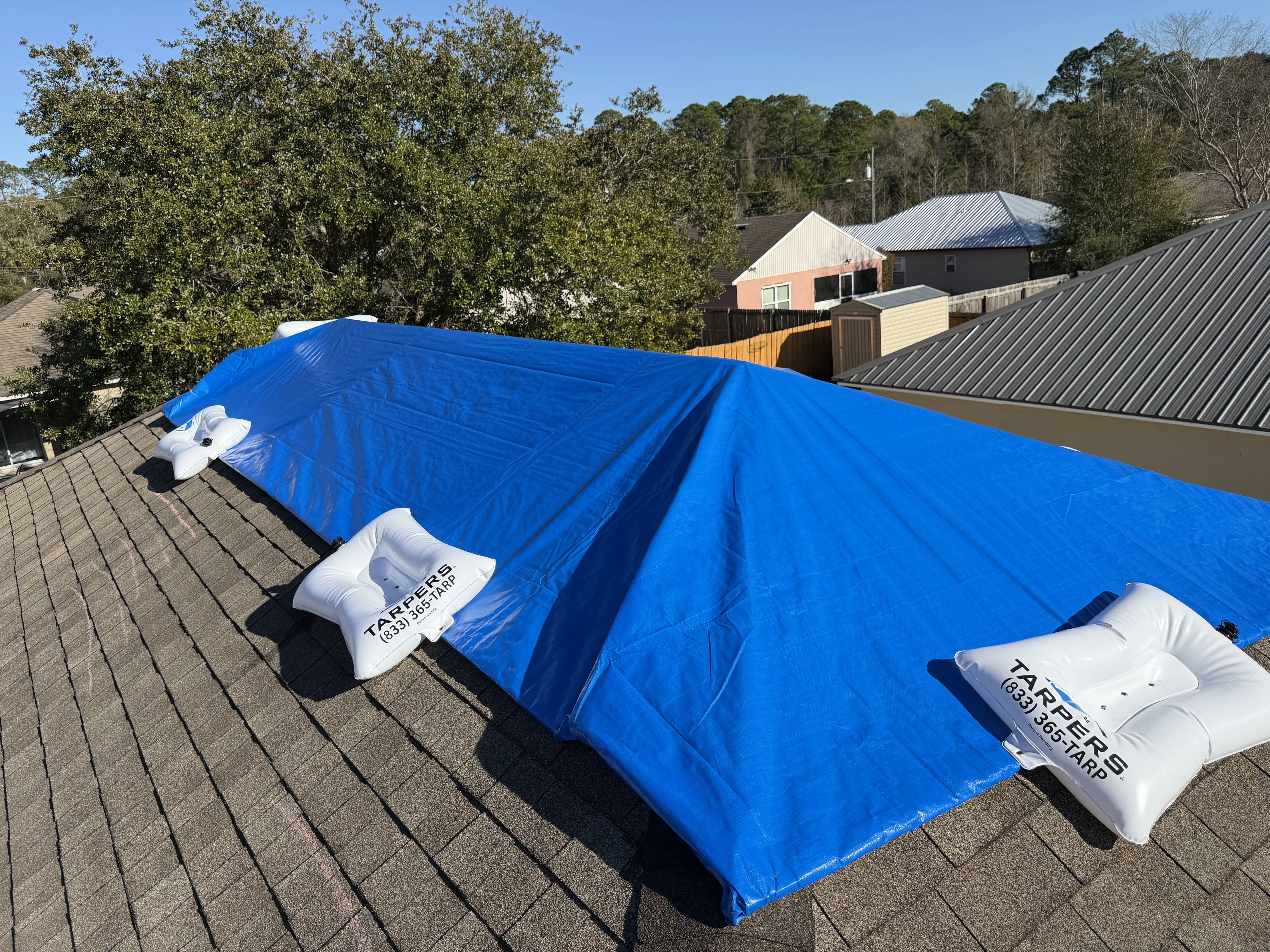
Emergency roof tarping is supposed to stop the bleeding. A crew shows up within hours of a storm, secures the damaged area, and buys the property time until permanent repairs can be scheduled. That is the plan. But when the tarp installation is done wrong, the plan falls apart fast, and the cost lands squarely on the carrier.
The pattern is well-documented across catastrophe response operations in Florida and the Southeast. A nail-down tarp gets installed in a hurry. The nails penetrate shingles and the underlayment beneath them. The tarp holds for a few weeks, maybe a month. Then it shifts, tears, or lets water in through the nail holes. By the time the adjuster returns, the interior damage has grown. Drywall that was dry at the initial inspection is now wet. Mold has started. The repair scope has expanded.
That second visit costs money. The expanded scope costs more. And the adjuster now has to untangle what was storm damage from what was vendor-introduced damage.
The Real Cost Breakdown
When you add up what a failed tarp actually costs a carrier, the number is almost always higher than the original mitigation invoice.
Start with the second deployment. Someone has to go back out to re-secure or replace the failed tarp. That is another dispatch, another crew, another invoice. In a catastrophe environment, that callback pulls resources away from new assignments.
Then there is the expanded interior damage. Water that got in during the gap between the first tarp failing and the second crew arriving has to be remediated. Wet insulation, damaged drywall, and any mold remediation that follows all add to the claim. These costs are directly traceable to the tarp failure, even if the documentation does not always make that connection explicit.
Adjuster cycle time is the third cost that rarely gets counted. A claim that should have closed in 60 days now runs 90 or 120 because of the supplemental inspection, the expanded scope negotiation, and the additional documentation required. That extended cycle time has a cost in adjuster hours, reserve adjustments, and policyholder friction.
Finally, there is the vendor relationship cost. A vendor who generates callbacks and supplemental claims is a liability in a carrier's network. Managing that relationship and eventually replacing the vendor consumes time and resources that should not have been necessary.
Why Nail-Down Tarping Creates These Problems
The core issue with nail-down tarping is that it introduces new penetrations into a roof that is already compromised. Every nail driven through a tarp and into a shingle is a potential new leak point. The tarp may cover those holes while it is in place, but the moment the tarp shifts, tears, or is removed, those penetrations are exposed.
In a nail-down installation, the tarp is also only as secure as the nails holding it. High winds, which are common in the same weather systems that caused the original damage, can pull nails loose or tear the tarp around them. Once the tarp starts to move, water gets underneath it, and the protection is gone.
The non-destructive tarping method that TarpBags® enables removes both of these failure points. TarpBags® are water-fillable anchoring bags that secure the tarp along its perimeter without any penetration of the roof surface. Crews carry the empty bags up the ladder, position them along the furring strips, and fill them with water from a standard garden hose. The weight of the filled bags holds the tarp in place without nails, without new holes, and without the secondary damage risk that nail-down methods carry.
What Adjusters See in the Field
Adjusters who work catastrophe claims in Florida and the Southeast have seen both methods up close. The difference at a follow-up inspection is significant.
A property protected with a non-destructive tarp looks the way it should. The roof surface is intact. The tarp is secure. The interior is dry. The adjuster can focus on the original storm damage and move the claim forward.
A property where a nail-down tarp has failed or shifted looks different. There may be additional water intrusion, new penetrations in the shingles that were not part of the original loss, and a revised scope to negotiate. That process adds time and cost to every claim it touches.
For vendor managers and TPAs building or auditing their contractor networks, the installation method is a meaningful quality signal. Vendors who use non-destructive methods generate fewer callbacks, fewer supplemental claims, and cleaner documentation. That translates directly to lower claim costs and shorter cycle times across a book of business.
Documentation Quality and Claim Defensibility
One underappreciated benefit of non-destructive tarping is what it does for claim documentation. When a tarp is installed without penetrating the roof, the original damage is preserved in its pre-mitigation state. Adjusters and contractors can document the storm damage accurately, without having to account for what the mitigation crew may have altered.
That matters in contested claims and when a carrier needs to defend a coverage decision based on the documented scope of the original loss.
TarpBags installations are also compatible with standard documentation workflows used in Symbility, Xactware, and CoreLogic platforms. The non-destructive method does not require any special handling in the estimate or any additional line items to account for vendor-introduced damage. The claim stays cleaner from the first inspection through final settlement.
Building a Network That Does Not Generate Callbacks
The vendors in a carrier's preferred network should be solving problems, not creating new ones. A tarp installation that fails, shifts, or introduces new damage is not a solved problem. It is a deferred cost that shows up later in the claim, in the adjuster's schedule, and in the reserve.
TarpBags gives carriers and TPAs a way to specify the installation method, not just the vendor. When the contract or dispatch instructions call for non-destructive tarping, the outcome is more predictable. The tarp holds. The roof stays intact. The claim moves forward.
For carriers managing large volumes of catastrophe claims across Florida and the Southeast, that predictability has real value. Fewer callbacks, shorter cycle times, and cleaner documentation add up across a full storm season.
To discuss how non-destructive tarping fits into your vendor network or TPA program, contact the Tarpers insurance partnerships team or call (833) 365-TARP.
Partner With Tarpers
Whether you are an insurance carrier, a TPA, or an adjuster looking for reliable non-destructive tarping vendors, we are here to help. Get in touch with our team.