
Why SLAs Matter More Than You Think in CAT Tarping
When a catastrophe event hits, the gap between a vendor who shows up and a vendor who performs to spec can cost a carrier thousands in supplemental claims, re-inspection fees, and delayed closures. That gap is almost always a contract problem, not a capability problem. A well-structured service level agreement with your emergency tarping vendor sets the performance floor before storm season, so you're not negotiating expectations in the middle of a CAT activation.
This post walks through the core components of a tarping vendor SLA that holds up under claims scrutiny, and what to watch for when evaluating or renewing vendor agreements.
Response Time: The Metric That Defines Everything Else
Response time is the most visible SLA metric, and it's also the most commonly misunderstood. Carriers and TPAs often specify a 24-hour response window, but that number is meaningless without a clear definition of when the clock starts.
Does the clock start at first notice of loss? At vendor dispatch? At adjuster confirmation? Each interpretation produces a different outcome, and vendors will default to whichever definition gives them the most slack.
A defensible SLA defines response time as the interval from confirmed dispatch to crew arrival on site, with a timestamp at both ends. For standard residential losses, 24 hours is a reasonable target in most markets. For CAT events, a tiered structure works better: 48 hours for the first wave of assignments, 72 hours for overflow, with escalation protocols if either threshold is missed.
Pair the response time requirement with a documentation trigger. The crew should capture a timestamped photo at arrival, before any work begins. That photo becomes part of the claim file and protects both parties if the timeline is ever disputed.
Scope of Work: Non-Destructive Method as a Contractual Requirement
The method your vendor uses matters as much as the speed. Nail-down tarping, where crews drive fasteners through the roof deck to anchor the tarp, creates secondary damage that complicates the original claim. It turns a wind-damaged roof into a roof with wind damage plus installation damage, and separating those two scopes in Xactimate or Symbility is time-consuming and often contentious.
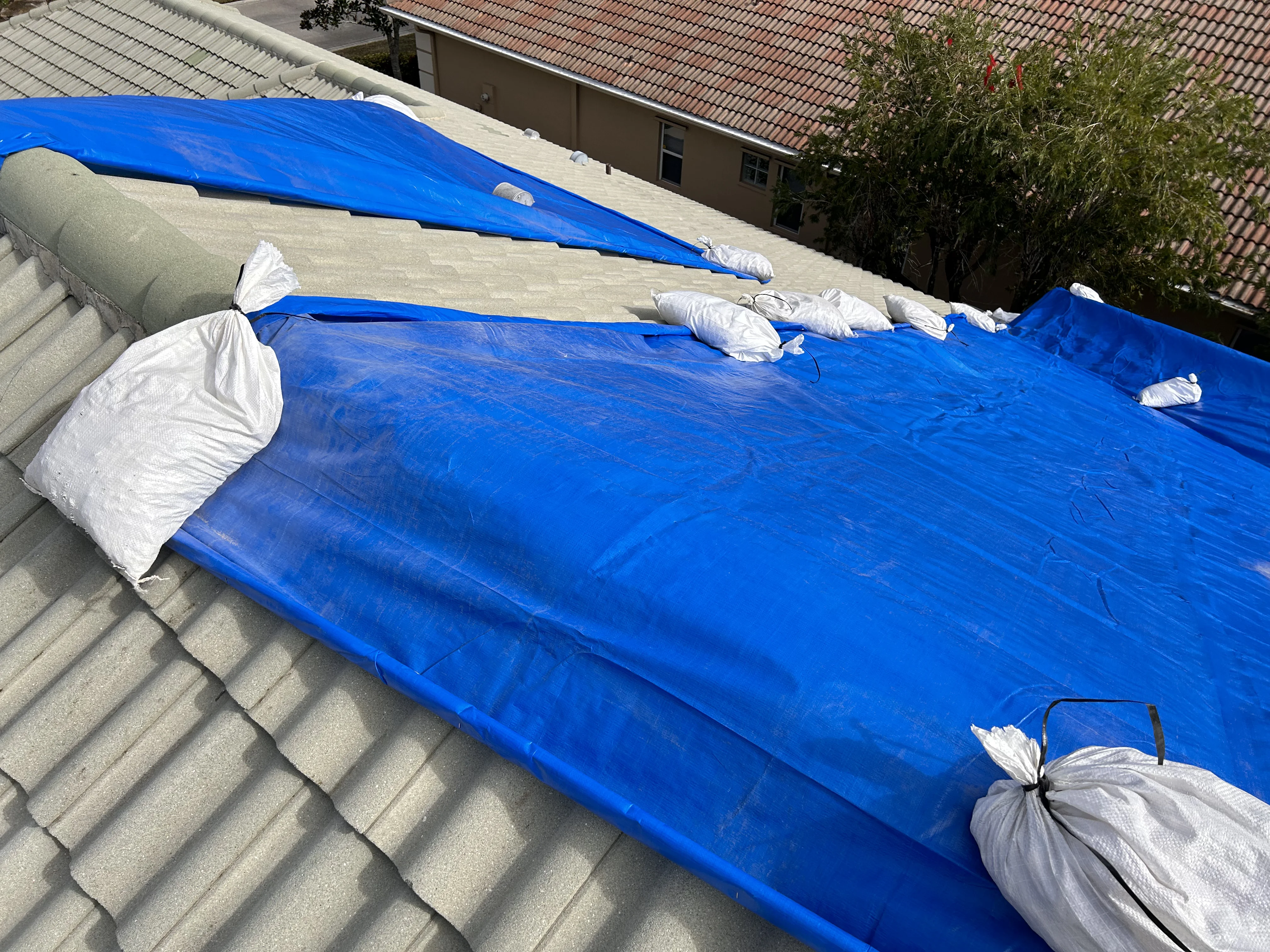
A well-written SLA specifies non-destructive tarping as the required method. TarpBags® are the clearest example of this approach: weighted ballast bags anchor the tarp without penetrating the roof surface, so the original damage scope stays clean and the tarp can be removed without leaving additional repair items behind.
Specifying the method in the SLA gives you a basis for rejection if a vendor substitutes a cheaper approach without authorization. Without that language, you're relying on the vendor's judgment in the field, which varies by crew and by workload.
Documentation Standards: What the SLA Should Require
Documentation requirements are where most vendor SLAs fall short. Carriers often specify that photos are required, but don't define what photos, at what resolution, in what format, or delivered by when.
A practical documentation standard for a tarping SLA should include:
- Pre-work photos showing the damage area before any tarp is placed, with GPS coordinates embedded or confirmed via the work order address
- Post-work photos showing the tarp in place, including all anchor points and the perimeter seal
- A materials log listing the tarp dimensions, ballast weight, and any supplemental materials used
- A completion timestamp, either from the crew's mobile app or a signed work order with date and time
For vendors using platforms like Symbility or Xactimate, the documentation package should be formatted to drop directly into the claim file without reformatting. That's not a luxury requirement. It's a workflow efficiency that compounds across hundreds of assignments during a CAT event.
See also: catastrophe response services and insurance vendor partnerships.
Performance Measurement: What to Track Between Events
An SLA that only gets reviewed after a failure isn't functioning as a management tool. Carriers and TPAs that run effective vendor programs track a small set of leading indicators between CAT events.
The metrics worth tracking on a quarterly basis:
- On-time arrival rate: percentage of assignments where the vendor arrived within the contracted window
- Documentation completion rate: percentage of jobs where the full documentation package was submitted within 24 hours of completion
- Supplement rate: percentage of jobs that generated a supplemental claim, which can indicate scope creep or method issues
- Re-inspection rate: percentage of jobs that required a second inspection due to tarp failure or improper installation
These numbers don't require a sophisticated reporting system. A shared spreadsheet updated by your TPA or vendor manager works fine for a regional program.
For more on industry documentation practices, PLRB publishes resources on vendor management and claims handling worth reviewing when building or updating your SLA framework.
Escalation and Remediation: What Happens When the SLA Is Missed
Every SLA needs a remediation clause, and most don't have one specific enough to be useful. A clause that says “vendor will make commercially reasonable efforts to remedy any deficiency” is not a remediation clause. It's a placeholder.
A functional remediation structure specifies what happens at each threshold. If the vendor misses the response window by more than four hours, the carrier has the right to reassign the job and charge the original vendor for any cost difference. If the documentation package is incomplete after 48 hours, the vendor is responsible for any re-inspection costs. If the supplement rate exceeds a defined threshold over a rolling 90-day period, the contract triggers a performance review.
These aren't punitive measures. They're the conditions that make the SLA a real management tool rather than a document that sits in a file until something goes wrong.
Building the SLA Into Your CAT Activation Protocol
The best time to negotiate SLA terms is before a CAT event, not during one. Vendors are more flexible on terms when they're not managing 200 active assignments, and carriers have more negotiating room when they're not under pressure to get roofs covered before the next rain event.
Build the SLA review into your annual vendor qualification process. Confirm the vendor's method aligns with your non-destructive requirement, that their documentation platform integrates with your claims workflow, and that escalation terms are current and enforceable.
If you're building or updating a tarping vendor program, the team at Tarpers works with insurance professionals across Florida and the Southeast to structure vendor relationships that hold up under CAT conditions. Reach out at (833) 365-TARP or visit the insurance vendor partnerships page.
Partner With Tarpers
Whether you are an insurance carrier, a TPA, or an adjuster looking for reliable non-destructive tarping vendors, we are here to help. Get in touch with our team.