
Claims managers and vendor managers already know that supplemental claims are expensive. What is less often discussed is how much of that supplemental volume is preventable, and how directly the choice of emergency tarping method drives it.
This is not a theoretical argument. It is a pattern that shows up in claim files across Florida and the Southeast every year, and it starts with a decision made in the first 48 hours after a storm.
The Tarping Decision Happens Before the Adjuster Arrives
When a storm hits, the first vendor on site is usually a tarping crew. Their job is to stop water intrusion while the property waits for a full inspection and repair estimate. That is the right call. Temporary protection reduces total loss severity when it works correctly.
The problem is that the most common tarping method, nail-down, introduces new penetrations into the roof surface as part of the protection process. Workers drive nails through the tarp and into shingles to hold the tarp in place. Those nail holes do not seal. They sit there, exposed, for weeks or months while the claim works through the adjustment cycle.
By the time the repair contractor shows up, those penetrations have often allowed water to track into the decking, the insulation, or the interior. The original storm damage is now compounded by damage introduced during the mitigation phase. That is a supplemental claim. And it was preventable.
The Math on Supplemental Frequency
Supplemental claims are not rare edge cases. In high-volume catastrophe markets like Florida, Louisiana, and the Carolinas, supplemental filings on residential wind and hail claims run at rates that materially affect loss ratios. A significant share of those supplements trace back to secondary water intrusion that occurred after the initial tarping.
The actuarial argument is straightforward. If a tarping method introduces new leak points, and those leak points produce water damage over a multi-week claim cycle, the expected supplemental rate for that method is higher than for a method that leaves the roof surface intact. The difference in claim frequency between nail-down and non-destructive tarping is not a rounding error. It is a vendor selection decision with measurable loss ratio consequences.
Carriers and TPAs that track supplemental rates by vendor and by method have the data to see this. Those that do not are absorbing the cost without visibility into the source.
Non-Destructive Tarping Changes the Equation
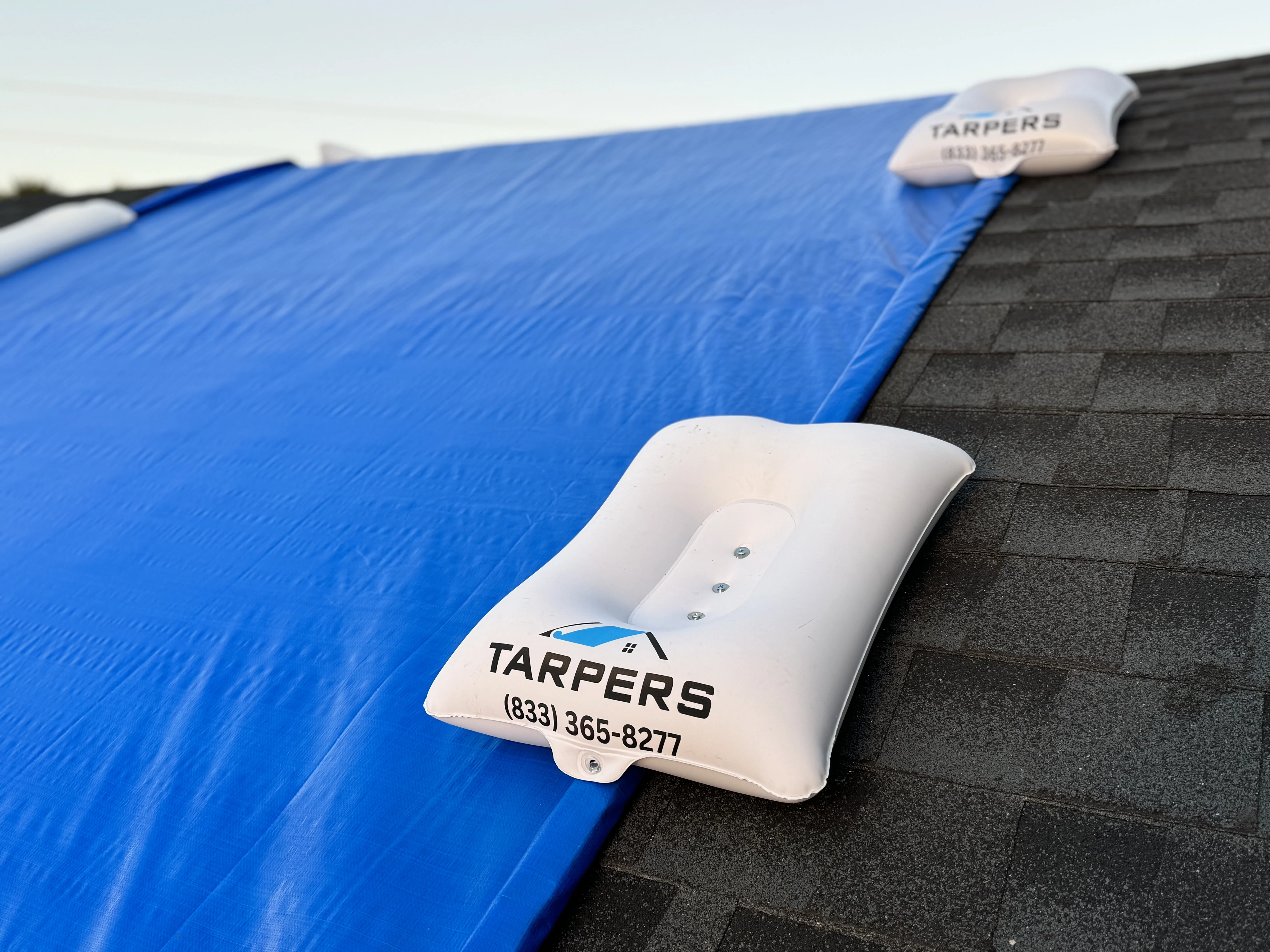
Non-destructive tarping, using TarpBags® as the anchoring system instead of nails or traditional sandbags, eliminates the penetration problem at the source. TarpBags® are water-fillable anchoring bags that crews position along the tarp perimeter and fill on-site using a standard garden hose. No nails. No new holes. No new leak points.
The roof surface stays intact through the entire temporary protection phase. When the repair contractor arrives, the damage scope reflects the original storm event, not a combination of storm damage and vendor-introduced penetrations. That is a cleaner claim file, a more defensible estimate, and a lower probability of a supplemental filing.
For claims managers working in Xactware or Symbility, the practical effect is that the initial estimate is more likely to hold. The scope does not expand because a tarping crew drove nails into shingles that were not part of the original loss. That matters for cycle time, for reserve accuracy, and for the relationship with the insured.
Vendor Selection Is a Claims Management Decision
This is the part that does not always get framed correctly. Vendor selection for emergency tarping is not just a field operations question. It is a claims management decision with direct consequences for supplemental frequency, reserve accuracy, and loss ratio.
When a carrier or TPA routes work to vendors using nail-down methods, they are accepting a known supplemental risk as part of the workflow. When they route work to vendors using non-destructive methods, they are removing that risk from the equation.
The Tarpers tarping method is built around TarpBags® and non-destructive installation. Every job is documented in a way that supports the claims workflow, including photo documentation of the roof condition before and after tarping, which integrates cleanly with CoreLogic and Xactware file management.
For vendor managers building or auditing their preferred vendor lists, the question worth asking is: what is the supplemental claim rate for each vendor on the list, and does that rate correlate with the tarping method they use?
What Claims Managers Should Ask Their Vendors
If you are a claims manager or vendor manager evaluating tarping vendors, these are the questions that matter:
Does the vendor use nail-down or non-destructive installation? If nail-down, what is their documented supplemental rate on tarped properties?
Does the vendor carry photo documentation of the roof surface condition at the time of tarping? That documentation is the baseline for any dispute about whether secondary damage predates or postdates the mitigation work.
Is the vendor's method non-destructive? Non-destructive tarping is the recognized best practice for temporary roof protection, which matters for both documentation and for the defensibility of the claim file.
Can the vendor integrate their documentation into your existing platform workflow? Tarpers documentation is structured to work with Symbility, Xactware, and CoreLogic-based file management.
Supplemental claims from tarping-induced damage are not inevitable. They are the predictable output of a method that introduces new penetrations into a roof surface that is already compromised. Switching to non-destructive tarping removes that output from the equation.
For carriers and TPAs operating in Florida and the Southeast, where storm frequency and claim volume are both high, the cumulative effect of reducing supplemental rates across a book of business is material. It shows up in loss ratios, in reserve accuracy, and in the time adjusters spend revisiting files that should have closed.
To discuss how Tarpers fits into your vendor program or to review our documentation standards, contact the Tarpers insurance partnerships team or call (833) 365-TARP. You can also review our approach to non-destructive tarping for insurance vendors and see how the method compares to standard nail-down installation.
External resources on mitigation best practices and claim frequency are available through insurancejournal.com and plrb.org.
Partner With Tarpers
Whether you are an insurance carrier, a TPA, or an adjuster looking for reliable non-destructive tarping vendors, we are here to help. Get in touch with our team.