
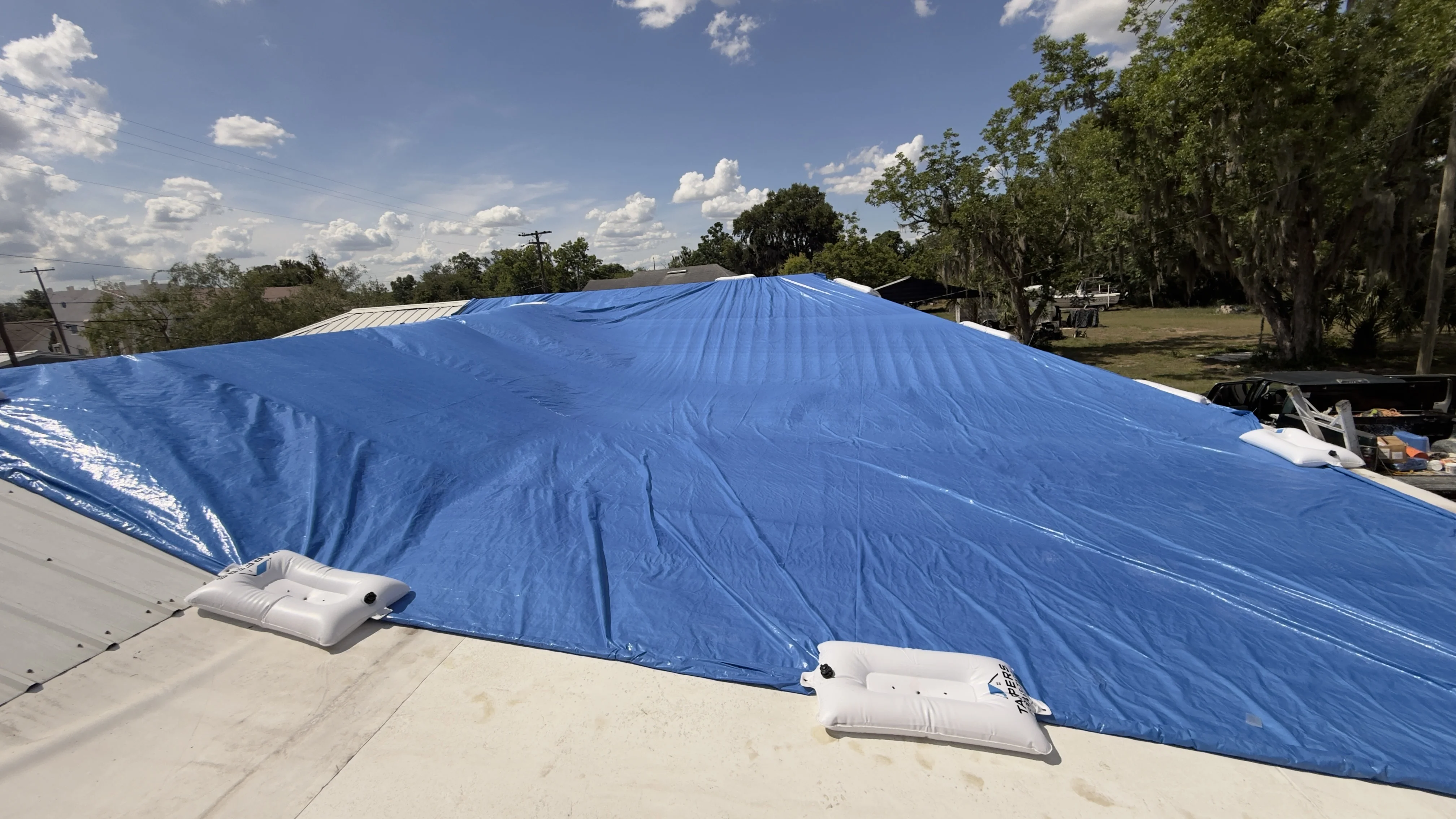
If you've been hearing the name TarpBags® more often in vendor conversations and carrier briefings, there's a reason. The product is showing up in field operations across Florida and the Southeast, and insurance professionals are starting to ask the right questions about what it actually is, how it works, and why it matters for claims outcomes. This is the explainer you've been looking for.
What TarpBags® Actually Are
TarpBags® are engineered water-filled anchoring bags designed specifically for emergency roof tarping. They replace both nails and traditional sandbags as the primary method for securing a tarp to a damaged roof.
The bags ship empty and flat. Crews carry them up the ladder without any significant weight load, position them along the furring strips that hold the tarp edges in place, and fill them with water from a standard garden hose directly on the roof. Once filled, the bags create distributed ballast weight along the tarp perimeter. No penetrations. No heavy lifting at height. No new holes in the roof surface.
That's the core of it. The engineering is straightforward, but the implications for claims management are significant.
Why the Old Methods Create Problems for Carriers
To understand why TarpBags® matter, you need to understand what the two dominant legacy methods actually do to a claim.
Nail-down tarping introduces new leak points. When a crew drives nails through a tarp and into shingles to hold it in place, those nail holes don't seal. Water finds them. Weeks or months after the original storm event, those penetrations can produce slow leaks that generate supplemental claims, additional adjuster visits, and disputes about what damage was storm-related versus vendor-introduced. The original loss gets compounded by a field decision made in the first 48 hours.
Sandbag anchoring creates field safety exposure. Hauling heavy sandbags up ladders to weight down tarp edges is physically demanding work at elevation. Falls from height remain among the leading causes of serious injury in construction and mitigation work. Carriers and TPAs that route work through vendors using high-risk field methods carry indirect exposure to workers compensation events and the operational disruption that follows them.
TarpBags® was built to remove both failure points from the job.
How the System Works in the Field
The deployment sequence is clean and fast. Crews arrive with the tarp, furring strips, and empty TarpBags®. The bags weigh almost nothing empty, so the ladder work is safer from the start. Once the tarp is positioned and the furring strips are in place, the bags go along the edges and get filled with a garden hose. The water weight holds everything down without touching the roof surface with a fastener.
When the job is done or the tarp needs to come off, the bags drain and pack flat. The roof surface is exactly as it was before the crew arrived, minus the storm damage that brought them there in the first place.
For adjusters working in Symbility or Xactware, this matters at documentation time. A roof protected with a non-destructive method looks materially different at the site visit. Repair scope stays focused on the original storm damage. There's no need to parse out what was pre-existing, what was storm-caused, and what was introduced by the tarping crew.
What This Means for Vendor Selection and Claim Economics
For vendor managers and carrier field ops, the practical question is whether TarpBags® changes the risk profile of the vendors you're approving and routing work through. The answer is yes, in a few specific ways.
Supplemental claim frequency drops. Non-destructive tarping eliminates the nail-induced penetrations that drive secondary loss filings months after the original event. The same tarp protecting the same roof produces fewer downstream complications when it's anchored with water weight instead of fasteners.
Documentation is cleaner. When an adjuster returns to a property that was protected with a non-destructive method, the scope of damage is easier to isolate. That's a real operational benefit during high-volume CAT events when adjuster bandwidth is stretched.
Vendor risk profile improves. Crews using TarpBags® aren't hauling heavy material up ladders. That's a meaningful reduction in the physical risk profile of the job, which matters for the vendors you're approving and the indirect exposure you carry when their crews get hurt.
Catastrophe surge scales better. During large loss events, the speed and safety of field deployment directly affects claim severity across a book of business. Methods that reduce the physical demands on crews can scale more cleanly when you're moving fast across hundreds of properties.
For more on how Tarpers structures its insurance vendor partnerships and what the claims-friendly workflow looks like end to end, the tarping method overview covers the operational details.
Where TarpBags® Fits in the Broader Claims Workflow
TarpBags® isn't a replacement for the adjuster's workflow. It's a field method that makes the temporary protection phase of a claim less likely to create problems downstream. The product was recognized in a May 2026 Insurance Journal feature as part of a broader conversation about reducing claim severity through better mitigation methods in the Southeast.
Tarpers is deploying TarpBags® across its operating crews in Florida and rolling the system out to catastrophe response operations in Texas, Louisiana, Mississippi, Alabama, Georgia, South Carolina, and North Carolina. If you're a carrier, TPA, or adjuster looking to understand how the system integrates with your existing vendor approval process, the insurance contact page is the right starting point.
You can also reach the team directly at (833) 365-TARP.
The product page at TarpBags® has the full technical specs, installation documentation, and field photos if you need them for a vendor review or carrier approval process.
Partner With Tarpers
Whether you are an insurance carrier, a TPA, or an adjuster looking for reliable non-destructive tarping vendors, we are here to help. Get in touch with our team.