
Most adjusters walk a tarp job and know something looks off. The tarp is bunched at one corner, or the furring strips are running the wrong direction, or there is a gap near the ridge that nobody seems to have noticed. But without a structured framework for what to look for, that instinct stays vague. It does not make it into the file notes. It does not drive a conversation with the vendor. And six months later, when the supplemental claim lands, nobody can trace it back to the installation.
This guide gives you five quality indicators you can assess at any emergency tarp site visit, whether you are working a single-family residential loss in central Florida or a multi-structure commercial claim after a Gulf Coast storm.
Indicator One: Tarp Coverage and Overhang
The first thing to check is whether the tarp actually covers the damaged area with enough margin to matter. A tarp that stops at the edge of the visible damage is not protecting the roof. Water does not respect the boundary of a hole. It runs, it wicks, and it finds the path of least resistance.
A properly installed tarp should extend at least two feet past the damaged area on all sides. At the eave, it should hang over the drip edge so water sheds off the roof rather than running back under the tarp and into the fascia. At the ridge, the tarp should either wrap over the peak or be sealed with a secondary layer to prevent wind-driven rain from entering at the high point.
When you see a tarp that barely covers the visible damage, that is a vendor who cut material costs at the expense of claim outcomes. Document it. The supplemental claim for interior water damage is already in motion.
Indicator Two: Furring Strip Placement and Fastening
Furring strips are the structural backbone of a tarp installation. They run along the tarp edges and at the ridge, and they distribute the load of the anchoring system across the tarp surface rather than concentrating stress at individual attachment points. When furring strips are missing, undersized, or improperly placed, the tarp is one wind gust away from failure.
Check that furring strips are present at the ridge and at each tarp edge. They should be running perpendicular to the slope, not parallel. They should be long enough to extend past the tarp edge so the anchoring system has something solid to bear against. And they should be secured in a way that does not introduce new penetrations into the roof surface.
This last point matters more than most vendors acknowledge. Nail-down furring strips create new holes in the shingles. Those holes do not seal when the tarp comes off. They become slow leak points that produce secondary claims months after the original event. A non-destructive tarping method that uses water-filled TarpBags® instead of nails eliminates this failure mode entirely. The furring strips stay in place without penetrating the roof, and the claim stays clean.
Indicator Three: Anchoring System Integrity
How the tarp is held down tells you a lot about how the vendor thinks about the job. There are three common anchoring approaches, and they are not equal.
Nail-through-tarp anchoring is the most common and the most problematic. Workers drive nails through the tarp and into the roof deck or shingles. The tarp holds, but the holes do not. Every nail is a future leak point. In Xactware and Symbility estimates, these penetrations rarely show up as a line item, but they show up later as supplemental claims.
Sandbag anchoring avoids the penetration problem but introduces a different one. Heavy sandbags carried up ladders create real safety exposure for field crews. Falls from elevation are among the leading causes of construction fatalities, and adding repetitive heavy lifting at height multiplies that risk. Carriers and TPAs that route work through vendors using sandbag methods carry indirect exposure to workers compensation events.
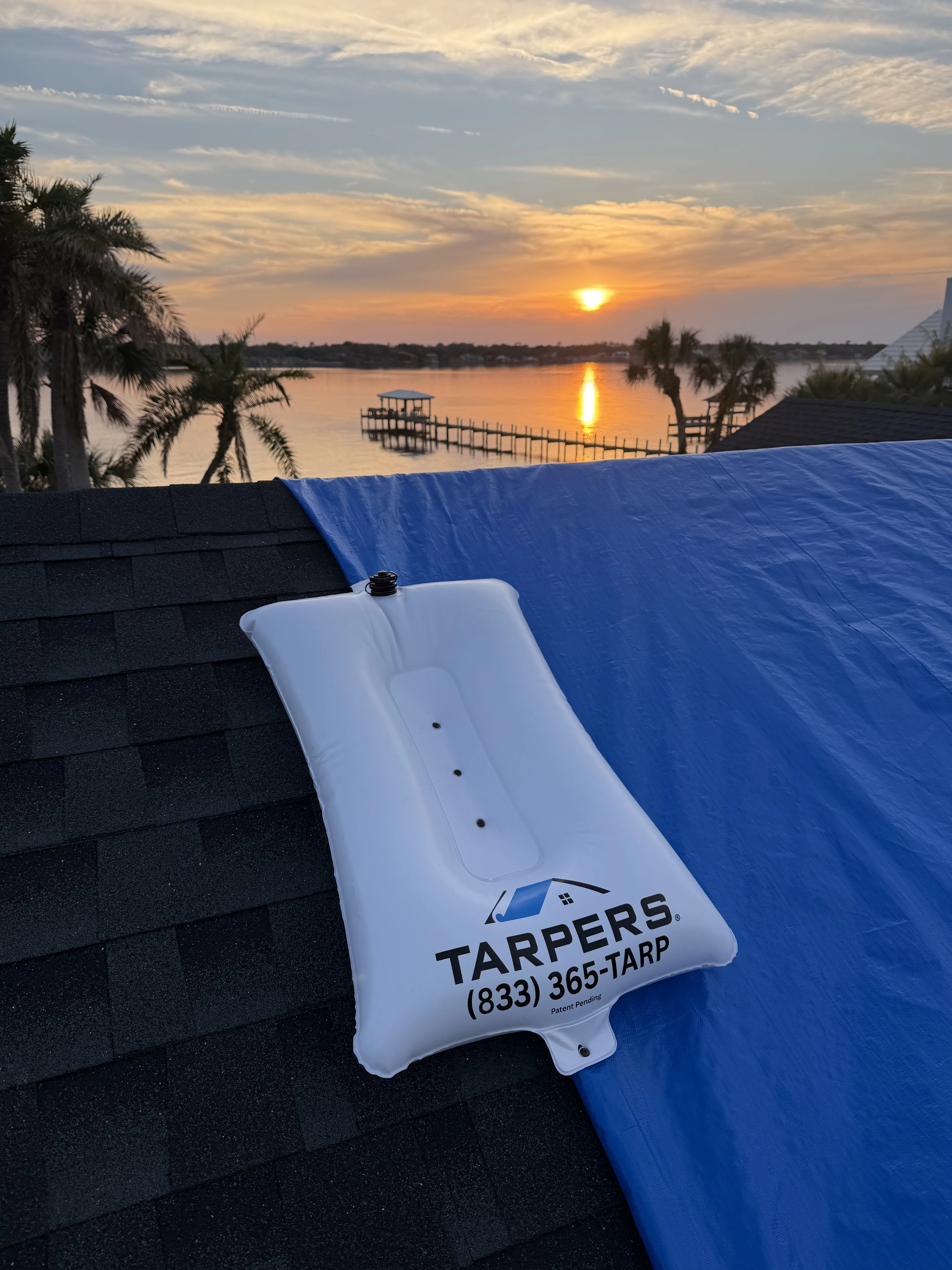
TarpBags® are a third option. They are water-fillable anchoring bags that crews carry up empty and fill from a garden hose on the roof. No nails. No heavy lifting. The filled bags create distributed weight along the tarp perimeter without penetrating the roof surface. When you see TarpBags® on a job, you are looking at a non-destructive installation that will not generate secondary claims from vendor-introduced penetrations.
Indicator Four: Ridge and Valley Treatment
The ridge and valleys are where most tarp installations fail. They are also where most adjusters stop looking carefully because the visible damage is usually somewhere else.
At the ridge, check whether the tarp is sealed or simply draped. A tarp that is draped over the ridge without a secondary seal is an open channel for wind-driven rain. During a storm, water will enter at the peak and run down the underside of the tarp, bypassing the protection entirely. A properly installed ridge treatment either wraps the tarp over the peak with a second layer secured on the opposite slope, or uses a ridge cap that seals the high point.
At valleys, check that the tarp is not creating a dam. A tarp edge that runs across a valley can redirect water flow and concentrate it in a location the original roof was not designed to handle. Vendors who do not account for drainage patterns at valleys are setting up interior water damage claims that will look like storm damage but trace back to the installation.
For adjusters working with IICRC or PLRB guidelines, ridge and valley treatment is explicitly addressed in best-practice documentation for emergency tarping. If the installation does not meet those standards, the vendor's work product is not defensible.
Indicator Five: Documentation and Photo Coverage
The final quality indicator is not about the tarp itself. It is about what the vendor left behind.
A professional tarping vendor should provide before-and-after photos of the installation, a written scope of work that identifies the damaged area, the tarp dimensions, the anchoring method, and the materials used. In Symbility and Xactware workflows, this documentation supports the estimate and reduces the back-and-forth that slows claim closure.
When a vendor shows up with a tarp and a phone photo of the finished job, that is not documentation. That is a liability. If the tarp fails, or if the property owner disputes the scope, or if a supplemental claim comes in six months later, the adjuster is working without a paper trail.
Ask vendors for their standard documentation package before you approve the work. If they do not have one, that tells you something about how they run their operations.
Putting It Together
These five indicators give you a structured way to assess any tarp installation in the field. Coverage and overhang. Furring strip placement and fastening. Anchoring system integrity. Ridge and valley treatment. Documentation.
None of them require specialized equipment. They require attention and a framework for what you are looking at.
If you are working with vendors who use non-destructive methods like TarpBags®, the anchoring indicator becomes much easier to assess. There are no nail holes to count, no penetration patterns to document, and no secondary claims waiting to surface. The installation either meets the coverage and structural standards or it does not.
For adjusters who want to go deeper on vendor qualification, the Tarpers completed projects gallery shows real installations with documentation. And if you are evaluating vendors for your carrier or TPA's preferred vendor program, the insurance vendor services page covers how Tarpers structures its carrier-direct relationships.
You can also reach the Tarpers team directly at (833) 365-TARP to discuss specific claim scenarios or vendor qualification questions.
The adjusters who catch installation problems early close cleaner claims. The ones who walk past them are the ones writing supplemental approvals six months later. The framework is simple. Use it.
Partner With Tarpers
Whether you are an insurance carrier, a TPA, or an adjuster looking for reliable non-destructive tarping vendors, we are here to help. Get in touch with our team.