
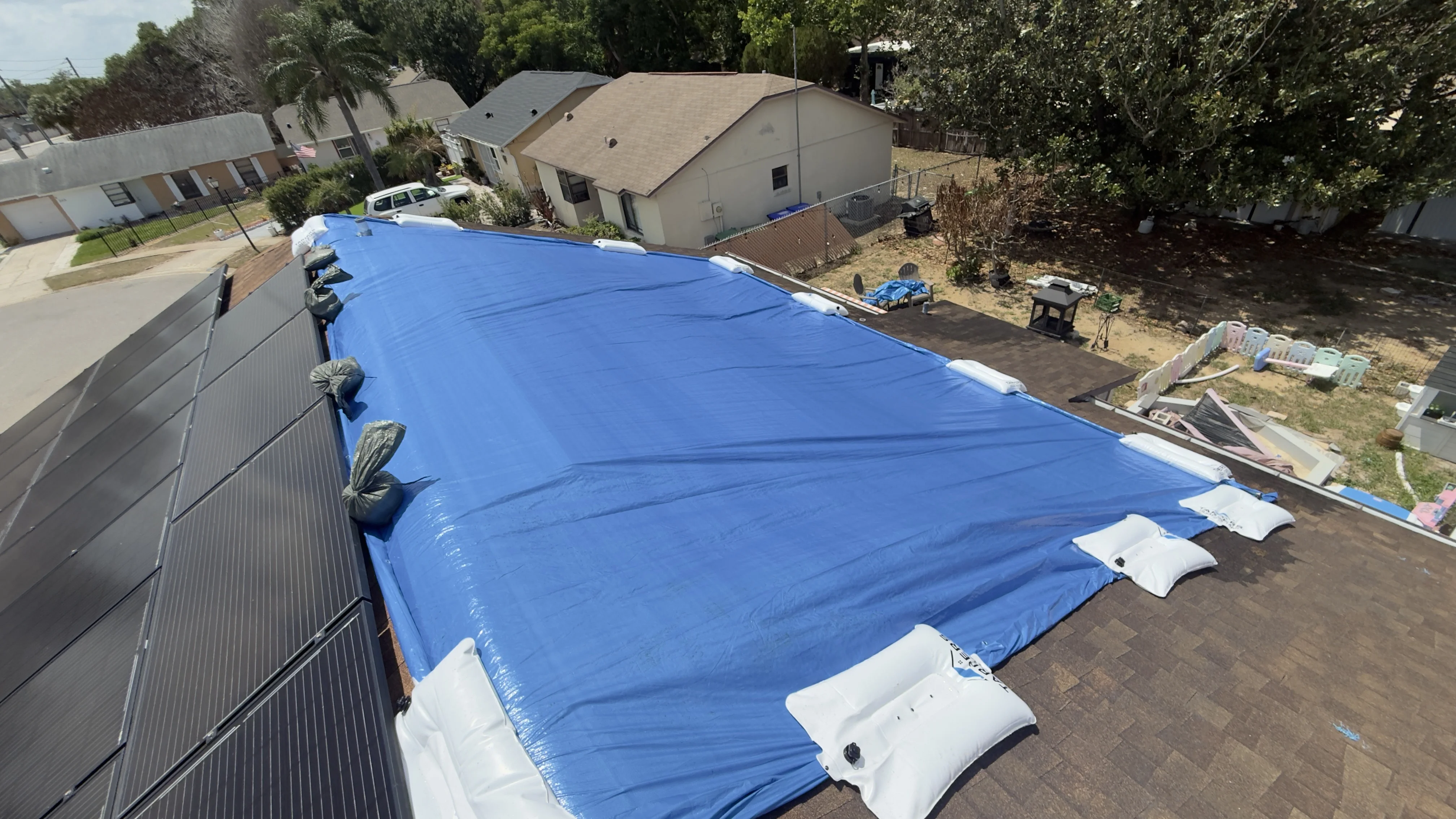
When a carrier's preferred vendor drives nails through a roof to secure a tarp, the claim doesn't end there. It restarts. Secondary leak claims, supplemental filings, and re-inspection costs follow months later, and the original storm damage gets buried under vendor-introduced complications. That pattern is why property insurance carriers across Florida and the Southeast are actively shifting their vendor requirements toward non-destructive tarping methods.
This isn't a fringe preference. It's a claims-economics decision.
The Real Cost of Nail-Down Tarping
Nail-down tarping has been the default field method for decades. Crews drive nails or screws through the tarp and into the roof deck or shingles, securing the edges with furring strips. It's fast, it's familiar, and it creates new penetrations in a roof that's already compromised.
Those penetrations don't seal when the tarp comes off. Water finds them. Six months after the storm, a property owner files a new claim for interior water damage. The adjuster visits, documents fresh staining, and now the carrier is managing a supplemental claim that traces back to the original mitigation vendor's method.
Xactware and Symbility both capture this pattern in claim data. Adjusters who work high-volume CAT books see it repeatedly: the nail-down tarp job that looked clean at initial inspection becomes a secondary loss event before the repair cycle closes. The cost isn't just the supplemental claim. It's the adjuster time, the re-inspection, the friction with the policyholder, and the potential for litigation if the property owner argues the vendor caused additional damage.
Carriers that have started tracking vendor-introduced secondary claims are finding that the method matters as much as the vendor's response time.
What Non-Destructive Tarping Actually Means
Non-destructive tarping means the roof surface is not penetrated during the temporary protection phase. No nails. No screws. No new holes introduced while the property is waiting for permanent repair.
The method Tarpers uses relies on TarpBags®, water-fillable anchoring bags that replace both nails and traditional sandbags. Crews carry the empty bags up the ladder, position them along the furring strips at the tarp perimeter, and fill them with water from a standard garden hose on the roof. The filled bags create distributed weight that holds the tarp without touching the roof surface with any fastener.
The non-destructive method means the roof comes out of the temporary protection phase in the same condition it entered. The original storm damage is documented. Nothing new has been introduced. When the adjuster returns for the repair scope visit, the damage picture is clean.
For Symbility and Xactimate users, this matters at the documentation level. A roof with no vendor-introduced penetrations produces a cleaner scope. The repair estimate reflects actual storm damage, not storm damage plus mitigation damage. That distinction affects reserve accuracy and cycle time.
Why Vendor Selection Is a Claims Management Decision
Vendor managers and claims managers at carriers and TPAs have historically evaluated emergency tarping vendors on response time, coverage area, and price. Those factors still matter. But the carriers moving fastest toward non-destructive requirements are adding a fourth criterion: method.
The reasoning is straightforward. A vendor who responds in four hours and drives nails into the roof may cost less per deployment than a vendor using TarpBags®. But if that nail-down deployment generates a supplemental claim six months later, the total cost of that claim event is higher. The initial deployment savings disappear, and the carrier absorbs the downstream cost.
Insurance Journal and the Insurance Information Institute have both covered the broader trend toward claim severity reduction through better field methods. The vendor selection piece of that conversation is catching up.
Carrier field ops teams that have started requiring non-destructive methods in their vendor agreements are seeing the downstream effect in their supplemental claim rates. The data is early, but the direction is consistent.
How Tarpers Fits Into Carrier and TPA Workflows
Tarpers operates across Florida and the Southeast with crews trained specifically on the TarpBags® non-destructive method. The workflow is designed to fit into existing carrier and TPA dispatch systems without requiring changes to how claims are assigned or tracked.
When a claim comes in, Tarpers crews deploy with TarpBags® as the standard anchoring method. The job documentation includes photos of the installed tarp, the anchoring configuration, and the roof condition before and after deployment. That documentation package is formatted to support Symbility and Xactware workflows, so adjusters aren't chasing additional documentation to close the mitigation phase.
For TPAs managing large vendor networks, Tarpers can operate as a preferred vendor for non-destructive tarping in Florida and Southeast markets. The insurance vendor services page has the details on how that relationship works, including coverage areas and dispatch protocols.
For carriers building or updating their vendor panels, the tarping method page covers the technical specifics of the TarpBags® system and how it compares to nail-down and sandbag methods on the metrics that matter for claim outcomes.
The Shift Is Already Happening
The carriers moving toward non-destructive tarping requirements aren't doing it because it sounds better. They're doing it because the claim data supports it. Secondary leak claims from nail-down tarping are a documented, recurring cost in high-volume CAT markets. The method that eliminates that cost is available, it's deployable at scale, and it fits into existing claims workflows.
Tarpers is built around that method. Every crew, every deployment, every documentation package is designed to support the carrier and TPA partners who are making vendor decisions based on total claim cost, not just initial deployment price.
If you're evaluating vendors for your Florida or Southeast markets, or if you're a claims manager looking at your supplemental claim patterns, the conversation is worth having. Reach out to the Tarpers insurance partnerships team or call (833) 365-TARP.
Partner With Tarpers
Whether you are an insurance carrier, a TPA, or an adjuster looking for reliable non-destructive tarping vendors, we are here to help. Get in touch with our team.