
The Cost Shift Most Carriers Miss
Storm season puts every line item under a microscope, and the pattern that keeps showing up in claims reviews is consistent: carriers that underinvest in the mitigation phase end up absorbing far more in restoration costs than they needed to. It's not a new problem, but it's one that still doesn't get enough attention at the operational level.
The gap between what a carrier spends on emergency mitigation and what it eventually pays for full restoration is where a lot of money quietly disappears. Understanding that gap, and closing it, is one of the more actionable levers available to claims leadership right now.
Why Mitigation Spend Gets Underweighted
There's a structural reason mitigation gets shortchanged. Emergency response costs show up immediately, as a visible line item, while the downstream savings from good mitigation are diffuse and harder to attribute. A claims manager reviewing a file sees the $800 tarping invoice. The $14,000 in avoided interior damage doesn't appear anywhere on that same file.
That attribution gap creates a quiet incentive to minimize upfront mitigation spend, even when the math clearly favors it. Adjusters working under cycle-time pressure sometimes approve the cheapest available option rather than the most effective one. Vendor managers focused on per-unit cost don't always have visibility into how mitigation quality affects total claim cost.
The result is a pattern where carriers pay less at the mitigation stage and significantly more at restoration. Industry observers have documented this dynamic across storm-heavy books, particularly in hurricane-exposed markets like Florida and the Southeast.
What Non-Destructive Tarping Actually Costs vs. What It Saves
The method matters as much as the price. Nail-down tarping, which is still common among lower-tier vendors, introduces secondary damage that wasn't part of the original loss. Fasteners driven through roofing materials create new penetration points. Removal causes additional tearing. What started as a wind-damaged roof becomes a roof with wind damage plus installation damage, and the restoration scope expands accordingly.
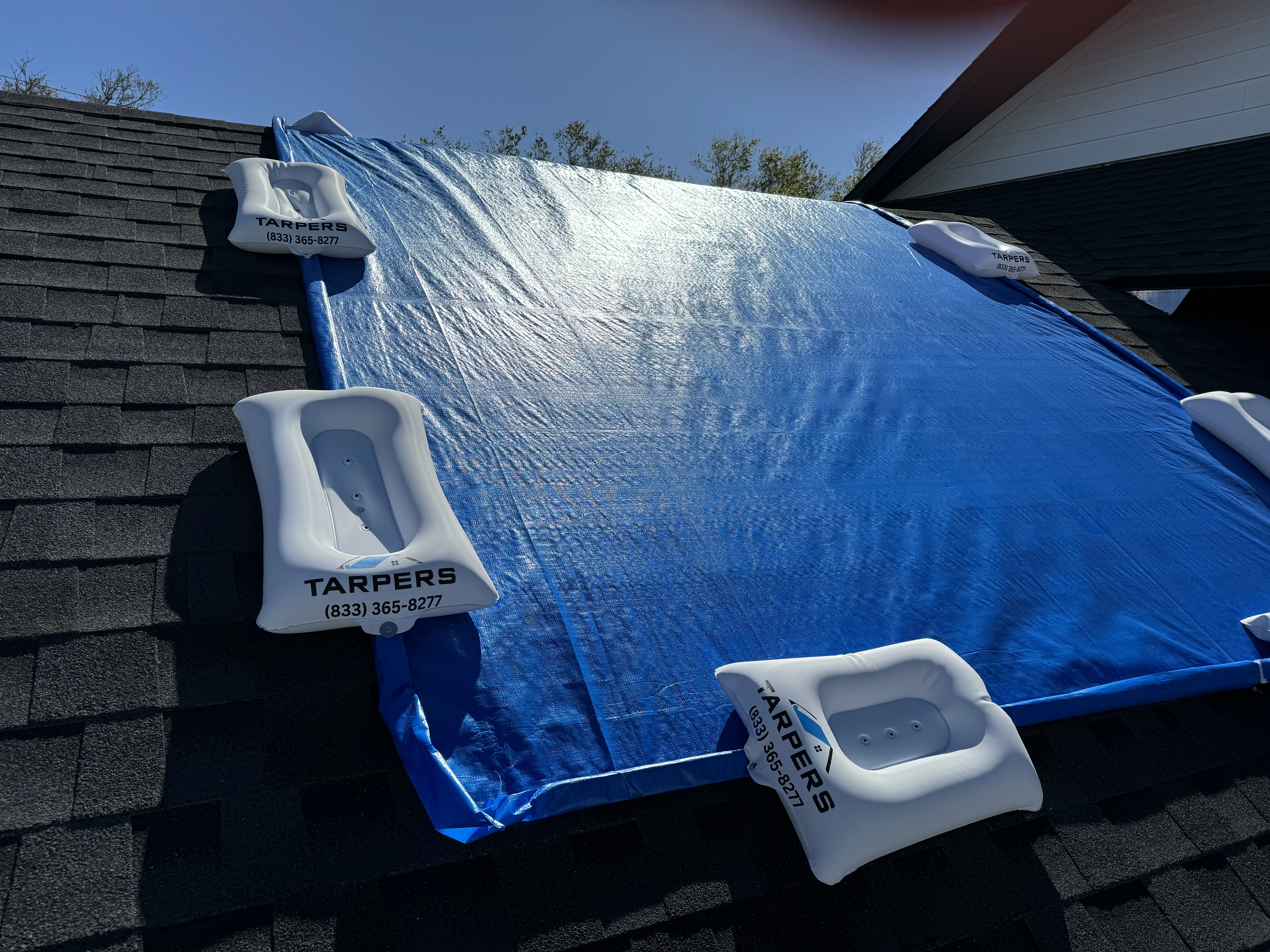
Non-destructive tarping avoids that compounding. TarpBags® are weighted and anchored without penetrating the roof surface, which means the damage footprint stays contained to what the storm actually caused. For adjusters writing scopes, that's a meaningful difference. For carriers reviewing total claim cost, it's even more meaningful.
The cost difference between a non-destructive tarp deployment and a nail-down deployment is typically modest at the mitigation stage. The cost difference at restoration, when you account for secondary damage remediation, is not modest at all.
Where the Restoration Bill Grows
Restoration costs expand for a few predictable reasons when mitigation is inadequate or delayed. Water intrusion that continues after the initial event causes secondary water damage, structural softening, and interior damage that compounds daily. A roof that was tarped poorly, or not tarped at all for 48 to 72 hours, can generate interior losses that dwarf the original roof repair estimate.
Carriers with storm-heavy books in Florida and the Southeast see this pattern repeatedly. A Category 1 or 2 wind event that should produce a manageable roof claim turns into a multi-trade restoration project because the mitigation window was missed or handled poorly. The Insurance Information Institute has tracked how water damage claims, in particular, tend to escalate when initial response is delayed or incomplete.
Vendor selection plays a direct role here. A vendor that deploys quickly, uses non-destructive methods, and produces documentation that holds up in the claims process is worth more than a vendor that's simply cheap. The National Association of Insurance Commissioners has emphasized documentation standards as a core component of sound claims handling, and that standard starts at the mitigation stage.
Documentation Quality and Its Effect on Cycle Time
One of the less-discussed costs in the mitigation-versus-restoration equation is documentation quality. A poorly documented mitigation deployment creates friction at every subsequent stage of the claim. Adjusters spend time chasing photos, measurements, and method confirmations. Supplements get disputed. Cycle time extends.
Good mitigation documentation, by contrast, moves the claim forward. When a vendor provides timestamped photos, GPS-confirmed deployment coordinates, and a clear record of what was covered and how, the adjuster can close the mitigation portion of the file quickly and move to scope. That efficiency has real value, both in cycle time and in the cost of claims handling.
Tarpers' catastrophe response operations are built around this standard. Every deployment produces documentation formatted for Symbility, Xactware, and CoreLogic workflows, so adjusters aren't translating field notes into platform-compatible formats. The documentation arrives ready to use.
What Senior Claims Leadership Can Do About It
The mitigation-versus-restoration cost gap is addressable, but it requires deliberate action at the vendor management and claims leadership level. A few things that move the needle:
Establish non-destructive tarping as the default standard in your vendor panel requirements. Nail-down methods should require explicit justification, not the other way around. This single policy change reduces secondary damage exposure across your entire storm book.
Build documentation requirements into vendor contracts, not just vendor guidelines. When documentation quality is a contractual obligation with defined standards, vendors produce better records and adjusters spend less time chasing them.
Review your mitigation-to-restoration cost ratios by vendor and by event. If certain vendors consistently produce claims where restoration costs are disproportionate to the initial loss, that's a signal worth investigating. The pattern is usually visible in the data before it becomes a reserve problem.
Connect your insurance vendor relationships to vendors who understand claims-friendly workflow, not just emergency response. The two aren't the same thing, and the difference shows up in your loss ratios.
The Operational Case for Getting Mitigation Right
The argument for investing in quality mitigation isn't complicated. Every dollar spent on effective, non-destructive emergency response has a measurable effect on what you spend at restoration. The challenge is making that connection visible in your claims data and your vendor management process.
Tarpers works with carriers, TPAs, and adjusters across Florida and the Southeast to provide emergency roof tarping that's fast, non-destructive, and documented for the claims process. If you're reviewing your storm response vendor panel or looking at ways to reduce restoration cost exposure, call us at (833) 365-TARP or visit our insurance partnerships page to talk through what that looks like for your book.
The cost shift is real. The question is whether it works in your favor or against you.
Partner With Tarpers
Whether you are an insurance carrier, a TPA, or an adjuster looking for reliable non-destructive tarping vendors, we are here to help. Get in touch with our team.