
Every adjuster knows the feeling: you open a vendor file and immediately see it's going to cost you time. Missing photos. No measurements. A tarp invoice with no scope notes. You've got thirty other files on your desk, and now you're chasing documentation that should have been there from day one.
That's not a one-off problem. It's a cycle time problem that compounds across your entire book.
Why Incomplete Files Slow Everything Down
When a mitigation vendor submits a file without adequate documentation, the claim doesn't move forward. It stalls. You send a request for additional information. The vendor responds days later, sometimes with partial answers. You follow up again. Meanwhile, the file sits in a pending queue, your cycle time climbs, and the policyholder is calling your office wondering what's happening.
This isn't just an inconvenience. In a high-volume environment, even a two-day delay per file adds up fast. If you're handling 200 active claims and 30% of your vendor files need follow-up, that's 60 files creating friction at any given time. The math isn't complicated, but the operational cost is real.
The root cause is usually the same: vendors who don't understand what adjusters actually need, or who treat documentation as an afterthought rather than a core deliverable.
What a Complete Mitigation File Looks Like
A well-documented roof tarping file should give you everything you need to close the scope without a phone call. That means timestamped photos taken before, during, and after installation. It means measurements that match the invoice line items. It means a clear description of the method used, the materials installed, and any site conditions that affected the work.
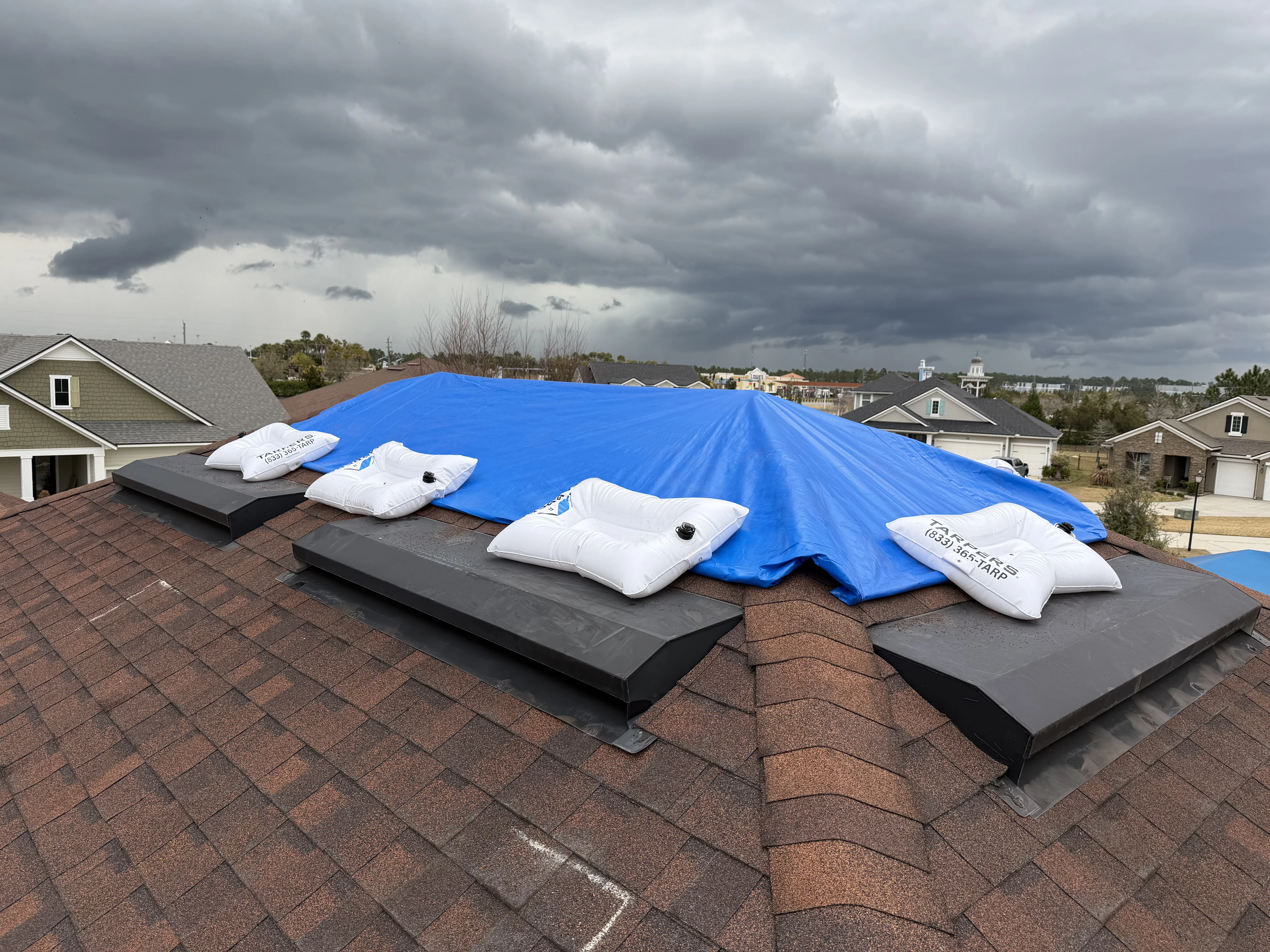
For non-destructive tarping specifically, the file should confirm that no fasteners were driven into the roof deck. That distinction matters for subrogation, for carrier guidelines, and for any downstream repair estimate. If you're working in Xactware or Symbility, the documentation should map cleanly to the line items you're writing. When it does, your review takes minutes instead of hours.
Tarpers builds every job file with adjuster review in mind. Photos are organized by phase. Measurements are included with the invoice. The method is documented as non-destructive tarping, which means no nail-down, no penetrations, and no secondary damage to write around later. TarpBags® hold the tarp in place without touching the roof surface.
How Documentation Quality Affects Carrier Review
Carrier field ops and vendor managers see patterns across thousands of files. Vendors who consistently submit complete documentation get faster approvals, fewer supplement requests, and better standing on preferred vendor lists. Vendors who don't get flagged, audited, and eventually removed.
From a carrier perspective, documentation quality is a proxy for vendor quality overall. If a vendor can't be bothered to take proper photos or write a coherent scope note, what does that say about how they actually performed the work? The file is the only record you have. It either supports the invoice or it doesn't.
This is why some carriers have started building documentation standards into their vendor agreements. They're not doing it to create paperwork. They're doing it because incomplete files cost money, and that cost is measurable.
The Cycle Time Argument for Choosing Quality Vendors
When you're evaluating mitigation vendors, price is an obvious factor. But cycle time impact is harder to quantify and often overlooked. A vendor who charges slightly more but submits complete files on the first pass will almost always cost less in total than a cheaper vendor who generates three rounds of follow-up per file.
Think about it in terms of adjuster hours. If your team spends an average of 45 minutes chasing documentation on a poorly submitted file, and that happens 60 times a month, you're burning 45 hours of adjuster time on administrative friction. That's more than a full work week, every month, just on follow-up.
Vendors who understand the claims workflow don't create that friction. They know what you need because they've built their process around your review requirements, not just around getting the job done and submitting an invoice.
You can review Tarpers' completed projects at /completed-projects to see how files are structured. For insurance vendor partnerships, visit /contact/insurance or the insurance vendor services page.
What to Look for When Vetting Vendors
If you're building or refining your preferred vendor list, documentation capability should be part of your evaluation criteria. Ask vendors how they structure their job files. Ask what photos they take and when. Ask whether their invoices include measurements and method descriptions.
You can also look at industry resources like PLRB and Claims Journal for guidance on vendor performance standards and documentation best practices. These organizations publish research and case studies that can help you build a more rigorous vendor evaluation framework.
The vendors who can answer your documentation questions clearly and specifically are the ones who've thought about it. The ones who give vague answers probably haven't.
Documentation quality isn't a soft metric. It's a direct driver of cycle time, and cycle time is a direct driver of cost. The vendors you choose determine which side of that equation you're on. To talk through how Tarpers documents its work or how we fit into your vendor workflow, call us at (833) 365-TARP or visit /contact/insurance.
Partner With Tarpers
Whether you are an insurance carrier, a TPA, or an adjuster looking for reliable non-destructive tarping vendors, we are here to help. Get in touch with our team.