
When a roof breach happens, the clock starts immediately. Every hour of exposure adds to the interior damage, and the relationship isn't linear. Water intrusion compounds. Drywall saturates. Insulation holds moisture. Secondary damage begins within 24 to 48 hours under the right conditions. For claims professionals designing vendor programs or evaluating mitigation timelines, the deployment window isn't just an operational detail. It's a cost driver that shows up directly in reserve accuracy and final settlement figures.
The question carriers and TPAs are increasingly asking isn't whether fast deployment matters. It's how to quantify the break-even point so vendor selection decisions can be defended with data.
Why the First 24 Hours Are Disproportionately Valuable
The first 24 hours after a roof breach represent the lowest-cost intervention window. The structure is still largely dry. Ceiling materials haven't failed. Personal property hasn't been exposed to sustained moisture. A properly installed, non-destructive tarp at this stage stops the damage curve before it inflects.
After 24 hours, the cost trajectory changes. Water migrates laterally through insulation and framing. Drywall begins to swell and separate. HVAC systems pull moisture through the structure. By hour 48, what started as a roof claim has often become a multi-room interior claim. By hour 72, you're frequently looking at interior remediation as a line item.
Adjusters working in Xactware or Symbility see this pattern in the scope. The roof line stays relatively fixed. But the interior line items grow with each day of delay. That's the mitigation cost curve in practice.
The Break-Even Math for Vendor Program Design
Here's how to frame the economics for vendor selection decisions. Assume a typical residential roof breach with a 400 square foot opening. A 24-hour deployment with a non-destructive tarp system costs roughly the same as a 72-hour deployment. The labor and materials are comparable. The difference is entirely in what happens to the interior during the gap.
Industry data from iii.org and claimsjournal.com reflect a consistent pattern in which water damage claims with delayed mitigation can run roughly 30 to 60 percent higher in total indemnity than claims where mitigation was completed within 24 hours. On a $40,000 interior claim, that's $12,000 to $24,000 in avoidable downstream cost. The mitigation vendor's fee is a fraction of that.
The break-even point is almost always well within the first deployment window. Paying a premium for a vendor with 24-hour response capability isn't a cost. It's a hedge against a much larger reserve exposure.
What Non-Destructive Tarping Changes About the Calculation
Traditional nail-down tarping introduces a secondary cost that doesn't show up in the initial mitigation invoice. Every nail penetration is a new potential leak point. Roofing contractors who come in after the claim often find that the tarp installation itself caused additional damage that needs to be addressed before the permanent repair can begin.
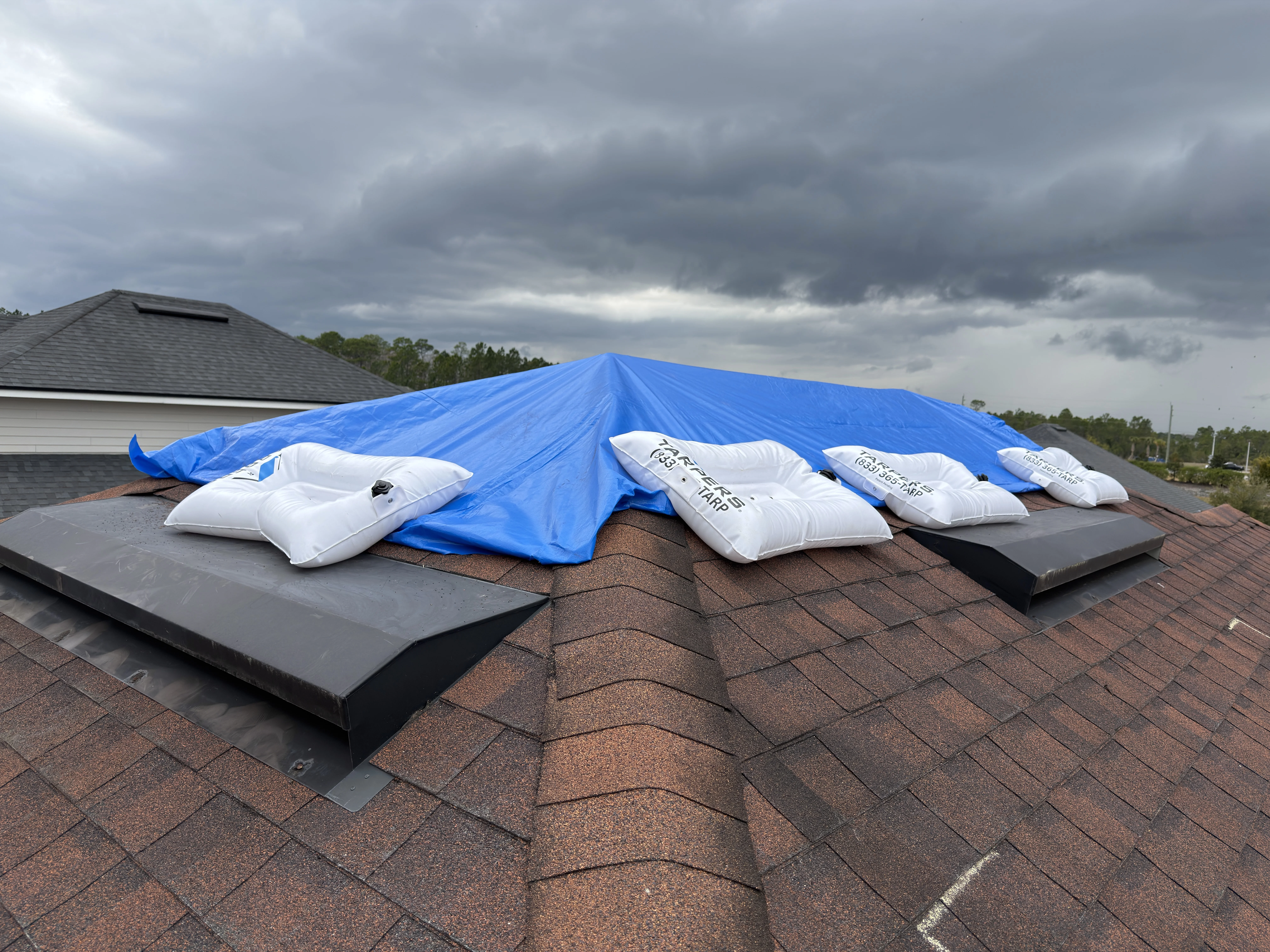
Non-destructive tarping, using TarpBags® instead of nails or screws, eliminates that secondary damage entirely. The tarp is secured with weighted bags at the perimeter and ridge. No penetrations. No additional repair scope. The roof is in the same condition after tarp removal as it was before installation.
For CoreLogic users tracking repair scope accuracy, this matters. The estimate you write after a non-destructive tarp removal is cleaner. There's no ambiguity about what damage was pre-existing versus tarp-related. That clarity reduces supplement frequency and speeds up the settlement cycle.
How Deployment Speed Affects Reserve Accuracy
One of the less-discussed consequences of delayed mitigation is reserve volatility. When a claim sits open with an unprotected roof, the adjuster is essentially writing a reserve against an unknown. Interior damage is still accumulating. The scope isn't stable. Supplements are likely.
A 24-hour deployment locks the damage scope. The adjuster can write a more accurate initial reserve because the structure is protected. Supplements related to ongoing water intrusion drop significantly. For carriers managing reserve adequacy ratios, this is a meaningful operational benefit that doesn't always get captured in the vendor selection conversation.
Catastrophe response programs that prioritize deployment speed over cost-per-square-foot often find that their total claim costs are lower, not higher. The mitigation line item is slightly larger. Everything downstream is smaller.
Building the Vendor Scorecard Around Deployment Economics
If you're a vendor manager or claims director building or revising a preferred vendor program, the deployment window should be a scored criterion, not just a checkbox. Here's a practical framework.
Tier vendors by their documented average response time from first notice of loss to tarp installation complete. Weight that metric at 30 to 40 percent of the total vendor score. Pair it with a non-destructive method requirement to eliminate secondary damage risk. Then track total claim cost by vendor tier over a 12-month period.
The data will show the break-even point clearly. Vendors who consistently deploy within 24 hours, using non-destructive methods, will show lower total indemnity on comparable claims. That's the quantitative argument that holds up in vendor program reviews and carrier audits.
Emergency tarping services built around this model are already operating in Florida and across the Southeast. The infrastructure exists. The question is whether your vendor program is structured to capture the benefit.
Putting It Into Practice
For adjusters, the practical takeaway is straightforward. When you're documenting a roof breach, note the time of loss and the time of tarp installation. That gap is a cost driver. If it's consistently over 48 hours with your current vendors, the reserve volatility and supplement frequency you're seeing is partly a vendor program problem, not just a weather problem.
For vendor managers, the economics favor a tiered approach. Maintain a primary vendor list with documented 24-hour capability and non-destructive method requirements. Use secondary vendors for overflow only, with clear escalation protocols.
For carrier field ops and TPAs, the insurance vendor program conversation should include deployment economics as a standard agenda item. The math is straightforward. The data is available. And the cost of inaction, measured in avoidable interior damage and reserve volatility, is quantifiable.
Tarpers operates across Florida and the Southeast with 24-hour deployment capability and the TarpBags® non-destructive method. For program inquiries, contact us or call (833) 365-TARP.
Partner With Tarpers
Whether you are an insurance carrier, a TPA, or an adjuster looking for reliable non-destructive tarping vendors, we are here to help. Get in touch with our team.